
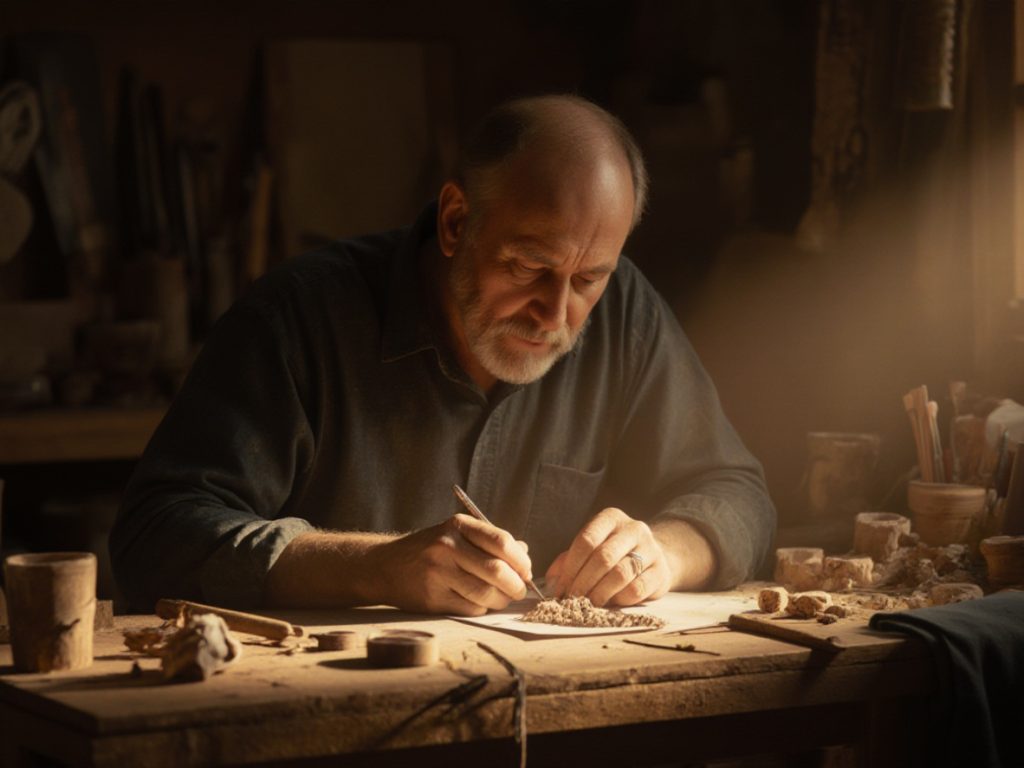
The Power of Witnessing Human Talent
No matter how advanced our tools become, there is something undeniably moving about watching another human being practice their craft. A guitarist bending a note with emotion. A painter laying down confident strokes. A designer sketching a building with quick, fluid lines. A baker shaping dough by hand. A child proudly showing a drawing that only makes sense to them.
Even in a world surrounded by automation, we remain captivated by skill — not because it’s efficient, but because it’s human.
There is beauty in watching someone do something they spent years learning to master. That mastery carries history, personality, and lived experience. It tells a story that can’t be automated or remixed from a dataset.
Why Authenticity Still Matters
In recent discussions across the creative community, one theme keeps surfacing: people love to see real skill because it represents something irreplaceable — intent, practice, meaning, and personal evolution.
We respond to human-made work for reasons that go far deeper than style or execution. It’s about:
- the visible evidence of effort
- the tension between risk and control
- the decisions made in real time
- the subtle imperfections that reveal a person behind the work
- the emotional fingerprints of the creator
AI can imitate skill, but it cannot replicate authorship. It cannot feel nervous before a performance. It cannot learn from a mistake. It cannot struggle late into the night to make something better. It cannot pour its lived experiences into a line, a note, or a gesture.
Authenticity moves us because it is personal.
The Human Story Behind Mastery
Every expert was once a beginner. Every skilled creative has a story filled with false starts, rough sketches, awkward attempts, and years of quiet practice. That journey is part of the value.
We don’t admire a violinist because they hit the right notes.
We admire them because they worked countless hours to learn how.
We don’t value a hand-drawn blueprint because it’s faster.
We value it because it reveals the architect’s mind at work.
We don’t cherish handmade pottery because it’s perfect.
We cherish it because imperfection tells a story of a human being’s hands.
Skill carries humanity.
Automation carries convenience.
They are not the same thing.
The Role of Skill in the Age of AI
AI can produce images, music, text, or models with impressive speed — but it does not create skill. It does not learn with intention. It does not grow. It does not develop taste or intuition. It does not refine itself because it cares about being better.
This is why, even as AI becomes more capable, people still gather around street performers, admire sketches in old notebooks, save children’s drawings on refrigerators, and watch behind-the-scenes footage of artists at work. We crave the human story. We want the connection that exists between creator and creation.
In a world full of synthetic shortcuts, human skill becomes even more valuable — not less.
Where CAHDD™ Fits Into This Landscape
CAHDD™ helps protect and highlight the human skill behind creative work. Through the TechRatio™, we make the human contribution visible rather than overshadowed by automated assistance. Through Humanocentricus™, we reinforce that skill development is more than technical execution — it is a reflection of identity, discipline, and humanity.
The movement doesn’t celebrate skill because it is rare.
It celebrates skill because it is meaningful.
A Human-Centered Invitation
We would love to hear about a skill you developed that changed you — something you practiced for years, something you struggled through, or something that helped you better understand yourself. These stories remind us why human skill will always matter.
CAHDD™ Creative Development Series
This index gathers our full collection of articles exploring childhood creativity, the human journey, and the core philosophies behind CAHDD™ and Humanocentricus™. Each article advances our mission to protect the human processes that shape imagination, taste, skill, and cultural evolution in the age of AI.
- Why Humanity Still Matters in the Age of AI: Protecting the Creative Journey
- Why Childhood Creativity Still Shapes the Adults We Become
- The Messy Sketchbook Matters More Than the Final Image
- Not Everything Is on the Internet: The Human Experience AI Cannot Access
- Fine Motor Skills, Focus, and the Slow Art of Becoming Human
- Why Real Skill Still Captivates Us in a Synthetic World
- The Danger of Cultural Stagnation When Creativity Is Outsourced to AI
- Human Taste Still Shapes AI — Not the Other Way Around
If you would like to contribute your story, share insight with future articles, or join CAHDD™ as an ambassador, we would love to hear from you.
This work reflects a CAHDD Level 2 (U.N.O.) — AI-Assisted Unless Noted Otherwise creative process.
Human authorship: Written and reasoned by Russell L. Thomas (with CAHDD™ editorial oversight). All final decisions and approvals were made by the author.
AI assistance: Tools such as Grammarly, ChatGPT, and PromeAI were used for research support, grammar/refinement, and image generation under human direction.
Images: Unless otherwise captioned, images are AI-generated under human art direction and conform to CAHDD Level 4 (U.N.O.) standards.
Quality control: Reviewed by Russell L. Thomas for accuracy, tone, and context.
Method: Computer Aided Human Designed & Developed (CAHDD™).