What this page is about:
The Core Principles define the ideas behind CAHDD™ and our belief that human authorship, creative agency, responsibility, and transparency should remain visible as technology becomes increasingly capable of participating in creative work.
Why it is important:
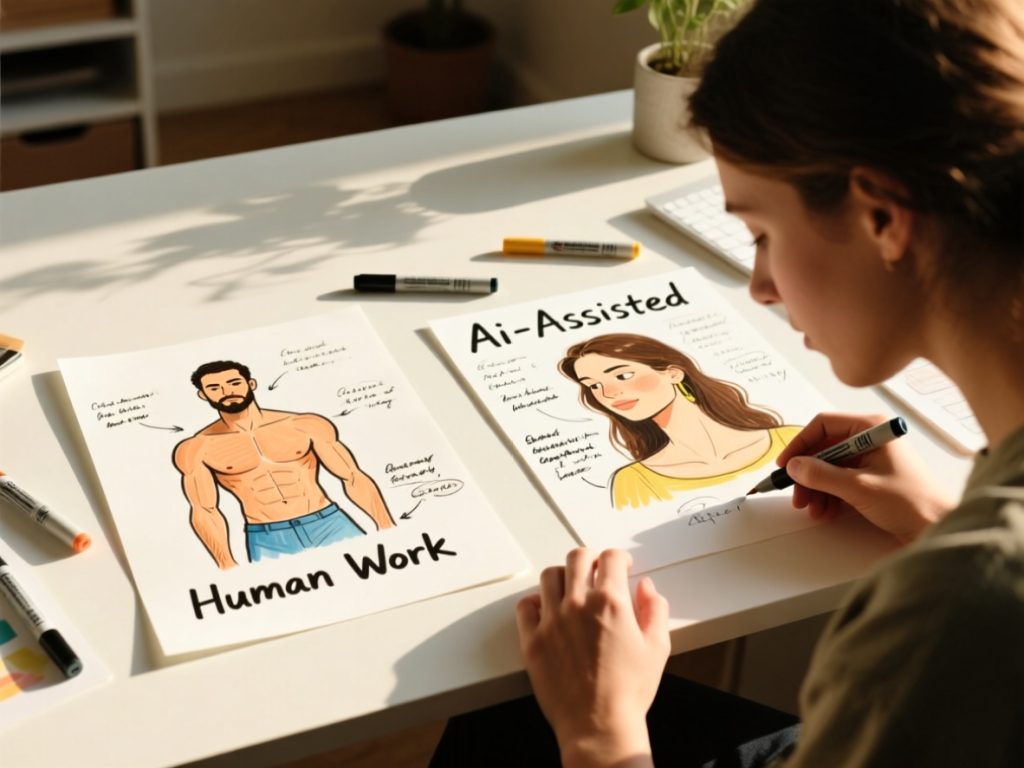
Technology has always changed how people create. Artificial intelligence is accelerating that change and making it increasingly difficult to know who, or what, created the things we see, hear, read, and experience. CAHDD does not ask creators to reject these tools. It asks that the human role remain visible.
Key takeaways:
- Human authorship deserves recognition.
- Technology should expand human capability without obscuring human responsibility.
- Creative processes can be described honestly without judging how creators choose to work.
- Transparency should be understandable to people, not hidden exclusively in metadata or technical systems.
- The creator should have a voice in describing how their work was made.
Best next step:
Visit How It Works to see how these principles become a practical system for communicating creative processes.
CAHDD™ is built around a simple idea: technology should serve human creativity, not make the human behind the work disappear.
Our principles are not rules for how people must create. They are a framework for preserving authorship, responsibility, choice, and trust while allowing creators to use the tools that make sense for them.
A pencil is a tool. A camera is a tool. CAD is a tool. Digital editing is a tool. Procedural systems, automation, and artificial intelligence are tools.
The tools change.
The importance of knowing who stands behind the work should not.
CAHD™ — Computer Aided Human Designed
CAHD™ is where the idea began.
Computer Aided Human Designed describes a relationship between people and technology in which the human remains the designer, author, decision-maker, and source of creative intent, while computers assist in carrying that intent forward.
The concept deliberately turns familiar technology language around. Rather than defining the human by the computer system being used, CAHD puts the human first.
Technology may calculate, simulate, automate, generate, refine, or accelerate. What matters is understanding the role those tools played and the role the human retained.
CAHD does not romanticize older tools or reject newer ones. It recognizes that creative practice continually evolves while asserting that human authorship remains worth identifying and preserving.
CAHDD™ — Computer Aided Human Designed & Developed
CAHDD™ expands the original CAHD concept beyond design to the much larger world of human creation and development.
Artists create. Musicians compose and perform. Writers write. Architects design. Engineers develop. Filmmakers tell stories. Craftspeople make. Researchers investigate. Developers build. Educators teach.
Across these disciplines, digital tools, automation, algorithms, and artificial intelligence are increasingly woven into the process.
CAHDD provides a shared language for describing those relationships.
It is not a certification of artistic merit. It does not declare one creative process superior to another. And it does not attempt to reduce creativity to a mathematical percentage of human versus machine effort.
Instead, CAHDD asks a more useful question:
What role did the human play in creating this work, and what role did technology play?
By making that relationship visible, creators can communicate their process while audiences, clients, collaborators, and communities gain meaningful context about the work they encounter.
The CAHDD™ Stages
The CAHDD Stages provide a simple, human-readable vocabulary for describing different creative workflows.
They are not rankings. A higher number does not mean better, worse, more advanced, or less legitimate. The stages describe how a work was created, particularly the relationship between human creative agency and technological assistance.
Stage 0 — Traditional Human Craft
Entirely human-created through physical or analog methods, without digital tools, automation, or AI.
Stage 1 — Digitally Assisted Creation
Digital tools are used under direct human control. The tools assist execution but do not generate creative content or make substantive creative decisions.
Stage 2 — Algorithmic / Procedural Assistance
Scripts, filters, simulations, parametric systems, procedural tools, and task-level automation assist the human creator. Generative AI does not create expressive content.
Stage 3 — Human–AI Hybrid Creation
A human-directed creative process in which AI assists with research, writing, grammar, refinement, enhancement, exploration, or other creative or support tasks while meaningful human authorship and direction remain central.
Stage 4 — AI-Generated, Human-Curated
AI generates expressive content while a human directs, prompts, iterates, selects, evaluates, curates, and approves the result.
Stage 5 — Fully Autonomous AI Creation
AI produces all or almost all expressive content with little or no meaningful human creative contribution beyond configuration, initiation, triggering, observation, or distribution.
Stage X — Hybrid or Multi-Phase Workflow
Complex workflows that combine substantially different processes, stages, contributors, or phases in ways that cannot be accurately represented by a single stage.
The stages are designed to make disclosure simple enough to be used in the real world.
A symbol, number, statement, signature, or mark can communicate something meaningful without requiring audiences to inspect metadata, understand software, or decode a technical provenance system.
Humanocentricus™ — A Human-Centered Philosophy
Humanocentricus™ expresses the broader philosophy behind CAHDD: technology should be developed and used around human needs, values, abilities, and well-being, rather than expecting humanity to reorganize itself around technology.
This is not a rejection of technological progress.
Human beings have always extended themselves through tools. Our history is filled with inventions that allowed us to see farther, build higher, communicate faster, calculate more accurately, and create things that previous generations could scarcely imagine.
Humanocentricus asks that progress remain connected to its purpose.
Technology should expand human possibility without unnecessarily diminishing human agency, identity, dignity, or responsibility.
We do not believe the future must be framed as human versus machine.
We believe it should remain human first, with technology in service to human purpose.
Creator’s Mark™ — Standing Behind the Work
For centuries, creators have placed their names, signatures, initials, stamps, seals, and marks upon the things they made.
Those marks communicated more than authorship.
They communicated responsibility.
I made this.
This represents me.
I stand behind it.
Creator’s Mark™ carries that idea into an era in which the origins of creative work are becoming increasingly difficult to see.
A Creator’s Mark is a visible human claim of authorship and accountability. It can accompany CAHDD disclosure to identify the individual, group, studio, or organization willing to stand behind a work and the creative decisions represented by it.
The mark is not meant to imply that no tools were used. Human creators have always used tools.
It says something more fundamental:
There is a human creator here, and that creator is willing to be identified with the work.
Machines can generate content.
Responsibility remains human.
TechRatio™ — Looking Deeper Into the Creative Process
Sometimes a single CAHDD Stage is enough.
Sometimes creators want to say more.
TechRatio™ provides a vocabulary for describing the relationship between human contribution and technological assistance in greater detail, particularly where creative workflows involve multiple tools, processes, or forms of assistance.
Its purpose is not to pretend creativity can be precisely measured as a percentage.
Creative contribution is rarely that simple.
Writing a melody, developing a concept, directing a performance, generating alternatives, editing an image, refining a model, selecting an outcome, and making the final creative decision are fundamentally different kinds of contribution.
TechRatio encourages creators to communicate those distinctions when additional context would be useful.
For musicians, artists, designers, writers, filmmakers, and other creators, this can help distinguish between work that was performed, composed, designed, recorded, written, generated, edited, enhanced, or otherwise technologically assisted.
CAHDD provides the broad stage.
TechRatio helps tell more of the story.
Human + Machine Integrity
The arrival of increasingly capable technology does not eliminate the possibility of collaboration between people and machines.
It makes honesty about that collaboration more important.
Human + Machine Integrity is the principle that neither human contribution nor technological contribution should be intentionally misrepresented.
Human-created work should not be falsely dismissed as machine-generated.
Machine-generated work should not be deceptively presented as entirely human-created.
AI assistance should not automatically erase human authorship, just as human selection of an AI-generated result should not automatically be described as equivalent to creating that result without generative assistance.
Integrity requires enough context for people to understand the difference.
CAHDD supports creators wherever they choose to work along that spectrum.
What matters is that we describe it honestly.
Creator Choice
Transparency should not mean surrendering control of creative identity to platforms, software companies, or automated detection systems.
Creators should have the ability to describe their own process.
Embedded provenance, metadata, content credentials, and other technical systems can provide valuable information. CAHDD supports technologies that improve authenticity and accountability.
But technical information alone is not enough.
It can be invisible to ordinary audiences, stripped from files, inaccessible without software, or interpreted without meaningful context.
CAHDD therefore supports visible, human-readable disclosure alongside technical provenance.
What is embedded may increasingly become part of the technological environment.
What is visible should remain the creator’s choice.
Transparency Without Judgment
CAHDD is built around disclosure, not accusation.
A Stage 0 work is not inherently better than a Stage 3 work.
A Stage 3 work is not inherently more creative than a Stage 4 work.
Different creators, industries, projects, and circumstances will make different choices.
Transparency allows those differences to exist without pretending they do not exist.
Audiences may value traditional craftsmanship. Clients may welcome AI-assisted efficiency. Artists may experiment across multiple stages. Studios may use different workflows for different projects.
CAHDD does not need to decide which choice is correct.
Our role is to help make the choice visible.
Authorship and Responsibility
Authorship is more than production.
It involves intention, judgment, direction, decision-making, and responsibility.
As automated systems become increasingly capable of producing finished-looking work, society will need clearer ways to distinguish between generating something, directing something, assisting with something, and actually standing behind something.
CAHDD places responsibility at the center of that distinction.
Tools do not accept professional liability.
Algorithms do not answer clients.
Software does not defend an artistic decision.
A model does not sign its name because it believes in what it created.
People do.
That human willingness to accept responsibility remains one of the strongest foundations of meaningful authorship.
Why These Principles Matter
We are entering a period in which determining how something was created may become increasingly difficult simply by looking at the finished result.
That changes more than art.
It affects journalism, entertainment, architecture, design, education, advertising, science, engineering, communication, and eventually almost every field in which people create, develop, document, or communicate ideas.
The answer cannot simply be to reject technology.
Nor should the answer be to accept the disappearance of human authorship as inevitable.
There is another path.
We can embrace useful tools while preserving human identity.
We can automate tasks without automatically surrendering authorship.
We can use artificial intelligence without pretending it was not used.
We can recognize AI-generated work without erasing meaningful human contribution where it exists.
And we can give creators a simple way to stand behind their work and tell audiences:
This is how I made it.
That is the foundation of CAHDD™.
Philosophy
Human First. Creativity First.
CAHDD begins with people.
Human experience, curiosity, judgment, imagination, culture, imperfection, emotion, and intent give creative work meaning. Technology can expand what people are capable of doing, but capability alone does not define why something should exist or what it should mean.
Our philosophy is therefore not anti-technology.
It is pro-human agency.
Transparency
Clarity Builds Trust.
Transparency works best when it informs rather than accuses.
CAHDD provides visible language that allows creators to communicate their process voluntarily and audiences to better understand the work they encounter.
The goal is not surveillance of creativity.
It is trust through clarity.
Integrity
Stand Behind What You Create.
Integrity begins when creators are willing to represent their process accurately and accept responsibility for the work they claim.
Whether something was made by hand, produced digitally, assisted by algorithms, developed with AI, or substantially generated by AI, honest attribution protects both creators and audiences.
The tools may change.
The responsibility to represent our work truthfully should not.
Stewardship
Shape the Future Intentionally.
Technological change is not something humanity merely witnesses.
We participate in deciding how technology is developed, adopted, normalized, and understood.
Stewardship means embracing innovation thoughtfully, protecting human agency where it matters, acknowledging consequences as well as opportunities, and leaving room for people to choose how they create.
The future of creativity does not need to belong exclusively to humans or machines.
It should remain a future humans have a meaningful role in shaping.