
A Quiet Truth We’re All Beginning to Feel
Across countless creative conversations — from design forums to LinkedIn threads — a pattern keeps emerging. Behind every debate about AI, every argument about tools, every fear of replacement or loss of value, lies a much deeper concern:
We are afraid of losing the parts of being human that creativity helps us develop.
Childhood imagination. Messy sketchbooks. Motor skills. Taste. Skill-building. Cultural evolution. Personal experience. Meaning. These human elements are not just “inputs” to creativity — they are what creativity is for.
What we are really protecting isn’t the industry.
It’s the human journey that shapes who we become.
Creativity Is a Human Development System, Not a Product Factory
Before creativity was a profession, a market, or an industry, it was a developmental engine. Drawing, building, singing, sketching, sculpting — all of these activities helped children learn how to think, see, and express themselves. They built motor skills, emotional intelligence, cognitive flexibility, cultural identity, and the ability to connect dots.
AI accelerates output, but acceleration is not development.
If humans skip the “becoming” stage, we lose the capabilities creativity was meant to build:
- patience
- judgment
- intuition
- sensory awareness
- emotional clarity
- personal voice
- resilience
- taste
These are not optional traits for a thriving society. They are foundational.
The Most Dangerous Misconception About AI
The real threat is not that AI is too powerful.
The real threat is that humans may stop cultivating their own abilities.
Machines do not weaken us.
Dependency does.
If people let AI handle all ideation, all invention, all exploration, all imagining, then we risk raising a generation of operators, not creators — one that can request but not originate.
Cultural stagnation doesn’t come from machines.
It comes from humans forgetting how to dream without them.
Why Human Experience Still Has No Substitute
AI can remix patterns beautifully, but it cannot experience life. It cannot feel awe, sorrow, nostalgia, longing, love, or wonder. It cannot remember the texture of childhood or the weight of loss. It cannot taste a memory or carry a story in its bones.
Human experience is the well creativity draws from.
AI cannot access that well — only imitate its reflections.
And yet, these lived experiences shape:
- our taste
- our sense of beauty
- our sense of place
- the atmosphere we create
- the stories we tell
AI can help refine or visualize an idea, but meaning comes from us.
Skill, Struggle, and the Slow Path to Mastery
Human skill captivates us not because it is perfect, but because it represents a story: years of practice, frustration, discovery, and persistence. We admire mastery because it reflects the human capacity to grow.
AI shortcuts bypass the pathway where character is formed.
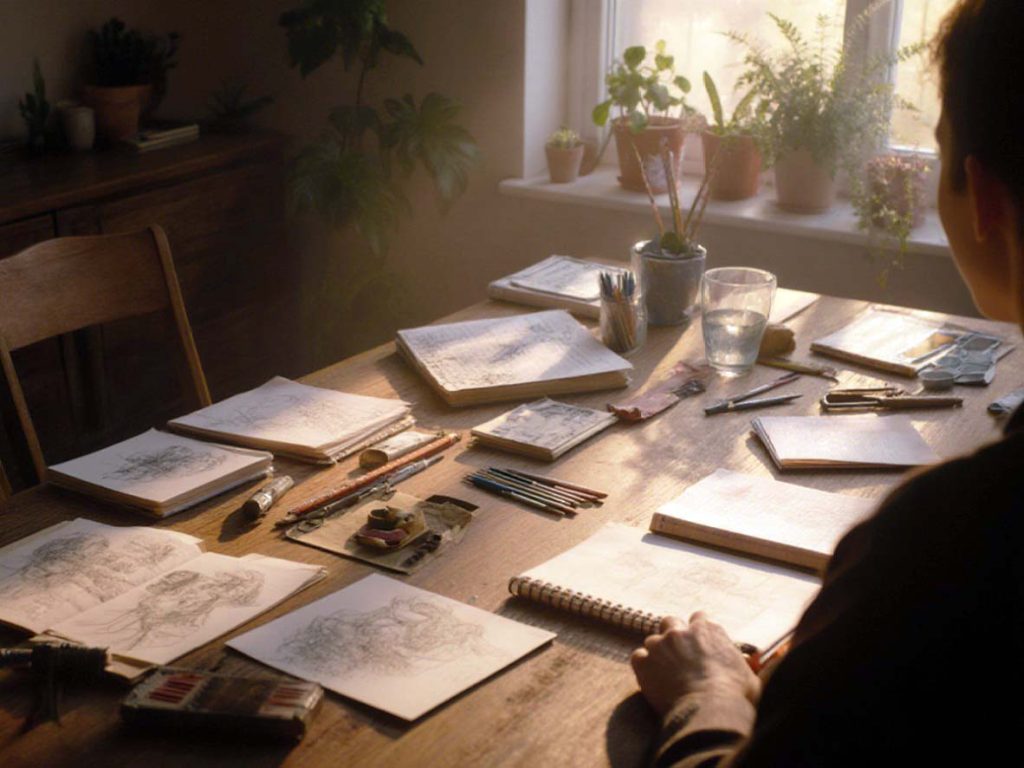
The messy sketchbooks.
The broken lines.
The lessons learned through the hands.
The awkward beginnings that shaped identity.
The creative muscles that took years to strengthen.
Skill matters because the journey matters.
We should protect that Slow Journey
Not because we fear technology, but because we understand what is lost when the process is removed. If creativity becomes a set of instant prompts and automated results, we lose the discipline, patience, and insight that the work was meant to teach. We risk raising a generation of creators who have results without foundation.
The Future of Creativity depends on Balance.
AI can be a powerful partner when used with awareness. But the heart of creative work still belongs to the human experience. It belongs to the time spent learning how to see. It belongs to the choices that reveal a person’s judgment. It belongs to the quiet hours where ideas first take shape. These moments build the inner world that no model can imitate.
Humanity still matters because Creativity is more than Output
It is a journey that shapes character, skill, and understanding. It teaches us how to think in ways that extend far beyond the page, the canvas, or the screen. Protecting that journey is not nostalgia. It is preparation. It ensures that as AI grows more capable, we remain the ones guiding the work, not the ones being shaped by the shortcuts it offers.
Human Taste Still Steers the Ship
Despite the hype, AI does not decide what counts as good. Humans do. Human taste trains the systems, judges the output, and sets the standard. If human taste becomes shallow or homogenized, AI follows. If human taste becomes experimental or bold, AI reflects that too.
Humans remain the creative steering wheel.
AI is just the engine.
Where CAHDD™ and Humanocentricus™ Come In
This is where the CAHDD™ philosophy becomes essential — not as a rulebook, but as a safeguard for human identity in an age of automation.
CAHDD™ helps preserve:
- human authorship
- human refinement
- human intention
- human skill
- human developmental processes
The TechRatio™ clarifies the balance of human vs. machine in any work, but the spirit behind CAHDD™ is even bigger:
Protect the journey.
Protect the meaning.
Protect the parts of humanity that creativity strengthens.
Humanocentricus™ expands this vision, reminding us that creativity is not just functional — it is emotional, developmental, philosophical, and communal. It is how we understand ourselves.
AI can accelerate the destination.
Creativity builds the person capable of walking the road.
A Human-Centered Invitation
We would love to hear your perspective. Which part of your creative journey shaped you the most — the early messes, the slow skill-building, the personal experiences, the cultural influences, or the development of your own taste? These stories matter. They remind us that creativity is not just a product — it is a human birthright.
CAHDD™ Creative Development Series
This index gathers our full collection of articles exploring childhood creativity, the human journey, and the core philosophies behind CAHDD™ and Humanocentricus™. Each article advances our mission to protect the human processes that shape imagination, taste, skill, and cultural evolution in the age of AI.
- Why Humanity Still Matters in the Age of AI: Protecting the Creative Journey
- Why Childhood Creativity Still Shapes the Adults We Become
- The Messy Sketchbook Matters More Than the Final Image
- Not Everything Is on the Internet: The Human Experience AI Cannot Access
- Fine Motor Skills, Focus, and the Slow Art of Becoming Human
- Why Real Skill Still Captivates Us in a Synthetic World
- The Danger of Cultural Stagnation When Creativity Is Outsourced to AI
- Human Taste Still Shapes AI — Not the Other Way Around
If you would like to contribute your story, share insight with future articles, or join CAHDD™ as an ambassador, we would love to hear from you.
This work reflects a CAHDD Level 2 (U.N.O.) — AI-Assisted Unless Noted Otherwise creative process.
Human authorship: Written and reasoned by Russell L. Thomas (with CAHDD™ editorial oversight). All final decisions and approvals were made by the author.
AI assistance: Tools such as Grammarly, ChatGPT, and PromeAI were used for research support, grammar/refinement, and image generation under human direction.
Images: Unless otherwise captioned, images are AI-generated under human art direction and conform to CAHDD Level 4 (U.N.O.) standards.
Quality control: Reviewed by Russell L. Thomas for accuracy, tone, and context.
Method: Computer Aided Human Designed & Developed (CAHDD™).