Apparently, we are all Replaceable it Seems?
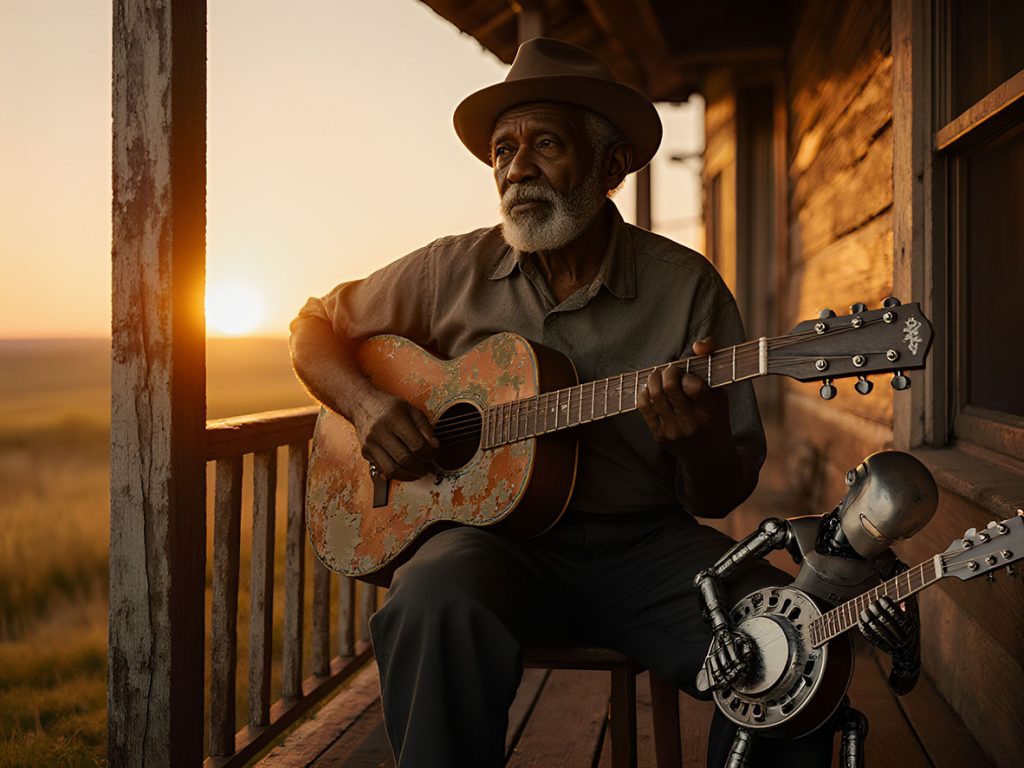
Every now and then, something cuts through the noise online and makes you stop. For me, it was a YouTube channel called RoboBlues — a self-described “AI Original Blues Rock” project that wears its digital DNA right on its sleeve. No fake band names. No smoke and mirrors. Just gritty, machine-made blues, with a twist of irony and a touch of soul that feels unsettlingly human.
The first time I heard it, I’ll admit, it gave me pause. I’ve spent decades around real musicians — guitars with scars, amps that hum, voices that crack. But what’s coming out of AI systems like this isn’t just noise; it’s style. Someone — a human — had to guide those algorithms, shape the prompts, balance the mix, and decide that this was how their machine should play the blues. And in that act of direction lies something deeply human.
That’s why RoboBlues deserves credit. It’s transparent. It doesn’t pretend to be a bar band from the bayou. It’s an experiment — a collaboration between code and creativity. And that honesty is exactly what CAHDD™ (Computer Aided Human Designed & Developed) stands for: not drawing battle lines between people and AI, but demanding clarity about who did what.
Yet I have to be honest — part of me mourns what’s happening. Art and music have always felt sacred to me. They were among the few things that made us feel human — the proof that we could create not because we had to, but because we needed to. When machines begin to share that space, it stirs something deep and uneasy. It’s not jealousy or fear. It’s melancholy — the quiet sadness that comes from watching something once uniquely human become something we now share with our own creations.
I don’t begrudge the technology. I understand its inevitability. But I miss the certainty that when a song moved me, it came from another beating heart.
So here’s to RoboBlues — for playing it straight, for letting the circuits wail, and for reminding us that authenticity isn’t about how the music was made… it’s about telling the truth about how it was made.
Closing thought:
Transparency is the first chord in this new song we’re all writing together. The question isn’t whether AI can make art — it’s whether we’ll have the courage to keep it honest, and the wisdom to remember what made it sacred in the first place.
This work reflects a CAHDD Level 2 (U.N.O.) — AI-Assisted Unless Noted Otherwise creative process.
Human authorship: Written and reasoned by Russell L. Thomas (with CAHDD™ editorial oversight). All final decisions and approvals were made by the author.
AI assistance: Tools such as Grammarly, ChatGPT, and PromeAI were used for research support, grammar/refinement, and image generation under human direction.
Images: Unless otherwise captioned, images are AI-generated under human art direction and conform to CAHDD Level 4 (U.N.O.) standards.
Quality control: Reviewed by Russell L. Thomas for accuracy, tone, and context.
Method: Computer Aided Human Designed & Developed (CAHDD™).