There is a new creative worldview spreading fast, especially among younger creators who grew up online, grew up with social media, and are now growing up with AI.
It is not framed as a theory. It is framed as freedom.
It says:
If you can imagine it, you can generate it.
If you can generate it, you can post it.
If you can post it, the algorithm will decide if it is “good.”
If it goes viral, it was meant to exist.
To many people, this feels like the most exciting moment in creative history. And in some ways, it is. Barriers are falling. Tools are multiplying. Experiments are happening at a scale that was impossible just a few years ago.
But every revolution also has a shadow. Every new freedom comes with a new addiction.
And the shadow behind this new creative religion is simple:
When output becomes the goal, authorship begins to disappear.
Not because people suddenly became dishonest, but because the culture stopped caring who made the work. The system rewards what spreads, not what was crafted.
That shift matters. Not for nostalgic reasons, but for the future of meaning itself.
First, let’s be honest: We use AI too
Before we go any further, let’s clear something up.
CAHDD is not an anti-AI movement.
We use AI constantly. Many of us use it daily. We use it for:
- ideation and brainstorming
- writing drafts and outlines
- generating reference images
- exploring style directions
- accelerating workflows
- producing variations
- building prompt libraries
- speeding up production and refinement
AI is a tool. A powerful one. A historic one. And it is already baked into the future whether we like it or not.
So this is not about shaming people who use AI.
This is about something more important:
How do we keep human meaning and human accountability alive inside the AI era?
Because it is very possible to embrace the tool and still lose the plot.
The new definition of “creative” is not craft, it is output
Traditionally, “creative” meant something like:
- learning a skill
- building taste
- practicing for years
- developing a personal style
- refining the details
- failing slowly until you get good
There was a long, hard path, and the work carried evidence of that path.
Now a new definition is taking over:
Creative means producing visible results.
It is not about the hand, the years, the sacrifices, or even the mastery. It is about being able to conjure something compelling and publish it.
In this worldview, AI creators can be considered the most creative because they can:
- synthesize ideas quickly
- connect concepts rapidly
- generate high-volume outputs
- test more ideas than anyone else
- publish daily or hourly
That is not necessarily wrong. That is a real form of creativity. It is experimentation creativity. It is speed creativity.
But it is not the same thing as craft.
And it is not the same thing as authorship.
Algorithms are not merit-based, they are momentum-based
One of the most seductive claims in modern creative culture is this:
“The algorithm decides what is good.”
It feels democratic. It feels like freedom from gatekeepers.
But algorithms do not judge quality. They amplify traction.
The algorithm is not asking:
Is this meaningful?
Is this honest?
Is this human?
Is this original?
Is this true?
It is asking:
Did people stop scrolling?
Did they click?
Did they share?
Did they react emotionally?
Did they argue?
Algorithms reward what spreads, not what is best.
This matters because once the algorithm becomes the judge, creators begin to shape themselves around the platform, not around the work.
That is how artistry becomes content.
And content becomes disposable.
Speed is real power, but speed has a cost
Let’s give credit where it is due.
AI allows creators to move at an almost insane speed. Instead of weeks, it can be minutes. Instead of years, it can be months.
You can create:
- posters
- thumbnails
- cinematic shots
- short films
- character designs
- songs
- narratives
- product concepts
- architectural mood images
And you can iterate again and again until you find what “hits.”
This is not fake power. It is real. It is transformational.
But here is the cost:
When the system rewards speed, the slow human layers get stripped away.
The layers that vanish first are:
- contemplation
- restraint
- ethical hesitation
- uncertainty
- personal fingerprint
- accountability for choices
Because those things slow you down.
So they get discarded.
Not because creators are immoral, but because the culture and the marketplace are training them to move faster than conscience.
Gatekeepers were flawed, but they protected one thing: provenance
Gatekeepers have always been controversial. Sometimes they were elitist. Sometimes they were corrupt. Sometimes they were biased.
But they did protect one thing that mattered:
The assumption that work came from someone.
That behind the work was a creator with a name, a skill, a reputation, and a body of work.
When you remove gatekeepers, you remove friction.
That can be healthy.
But when you remove friction in a world where AI can generate infinite outputs, you also remove the default expectation of provenance.
And provenance is not an academic word. It just means:
Where did this come from?
If we lose the habit of asking that question, creative culture shifts from authored work into endless anonymous production.
The vanishing author is not just about ego, it is about responsibility
This is where the conversation gets serious.
Authorship is not about applause.
Authorship is about accountability.
If you do not know who made something:
- Who owns the idea?
- Who is responsible for the message?
- Who is accountable for the consequences?
- Who is entitled to credit?
- Who is entitled to protection?
- Who is building a reputation you can trust?
In the old world, your work was tied to you.
In the new world, output can float around detached from any person, any intention, and any responsibility.
That is not liberation.
That is cultural amnesia.
And if we normalize that, we are training an entire generation to believe:
It does not matter where things come from, as long as they perform.
That is not just a creative shift. That is a moral shift.
The real danger is not AI, it is creative nihilism
When authorship disappears, something else starts to disappear too:
Meaning.
You may still feel entertained. You may still feel impressed. You may even feel inspired.
But the deeper human question fades out:
Why was this made?
Because human-made work carries intention. It carries history. It carries struggle. It carries personality. Even when it is imperfect.
If a piece of work might have been made by anyone, or by anything, the work becomes less like a message and more like a stimulus.
We still react, but we stop connecting.
That is where creative culture risks sliding into nihilism.
Everything becomes:
- aesthetic without origin
- emotion without responsibility
- art without the artist
- beauty without a human hand behind it
And that is a bleak future, even if it looks pretty.
A better path: human-centered AI creators
The younger AI generation does not need to be mocked. It needs to be mentored.
Not because older artists are “better,” but because the young are being trained by forces they do not fully see yet:
- platform incentives
- viral feedback loops
- engagement addiction
- output worship
- identity built on performance
We should not shame them for using the tools.
We should invite them into something higher:
Yes, use AI.
Yes, move fast.
Yes, experiment.
Yes, break patterns.
But also:
Claim your authorship.
Leave your fingerprint.
Be transparent about your pipeline.
Build a reputation.
Protect the human layers.
Be accountable for your choices.
That is not gatekeeping.
That is dignity.
CAHDD is not a rejection of AI, it is a defense of the human fingerprint
CAHDD exists for a simple reason:
We believe creative work should still carry visible evidence of human intention.
We believe creators should be able to say:
“This came from me.”
“This reflects my choices.”
“This represents my taste.”
“This is part of my legacy.”
And if AI was involved, we do not hide it.
We document it. We disclose it. We rate it.
Not to shame anyone, but to protect trust.
Because when trust collapses, the only thing left is manipulation.
And the algorithm loves manipulation.
If Authorship Still Matters to You
If you have ever looked at a piece of work and thought, “I want to know who made this,” then you already understand what this movement is about.
CAHDD supports visible human authorship in an age where it is increasingly easy to blur the origin of creative work. We use AI tools ourselves, and we believe they can be valuable, but we also believe the future depends on transparency, trust, and human accountability staying visible.
If you believe the future should include both powerful tools and honest disclosure, we welcome you.
This work reflects a CAHDD Level 2 (U.N.O.) — AI-Assisted Unless Noted Otherwise creative process.
Human authorship: Written and reasoned by Russell L. Thomas (with CAHDD™ editorial oversight). All final decisions and approvals were made by the author.
AI assistance: Tools such as Grammarly, ChatGPT, and PromeAI were used for research support, grammar/refinement, and image generation under human direction.
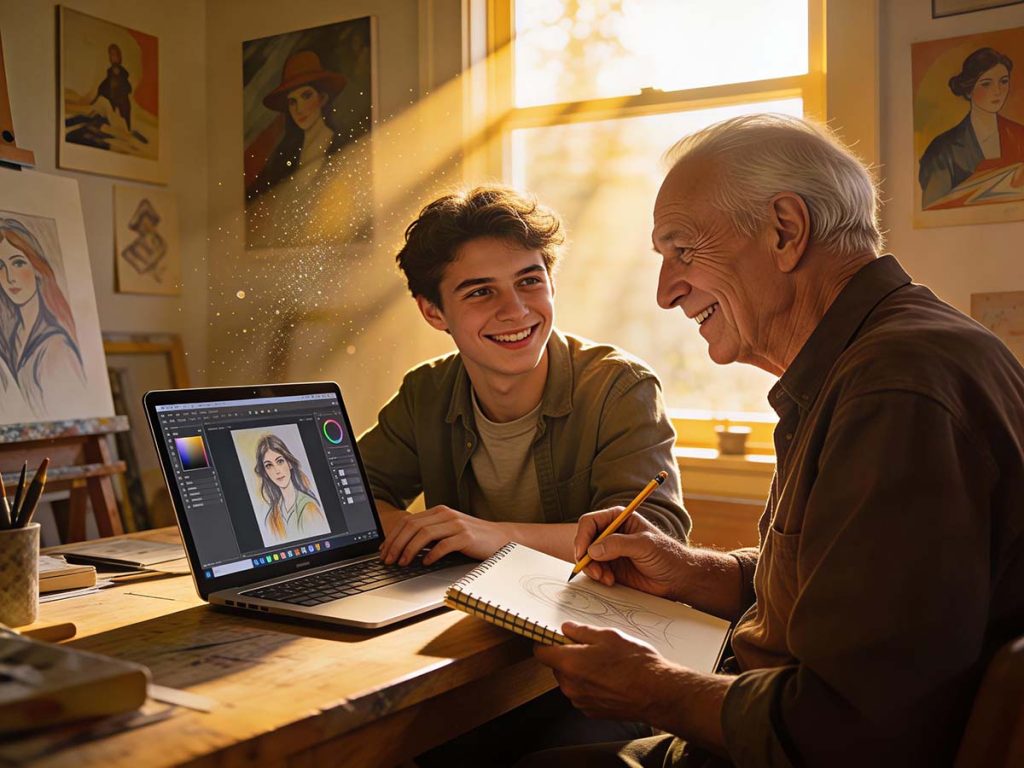
Images: Unless otherwise captioned, images are AI-generated under human art direction and conform to CAHDD Level 4 (U.N.O.) standards.
Quality control: Reviewed by Russell L. Thomas for accuracy, tone, and context.
Method: Computer Aided Human Designed & Developed (CAHDD™).