
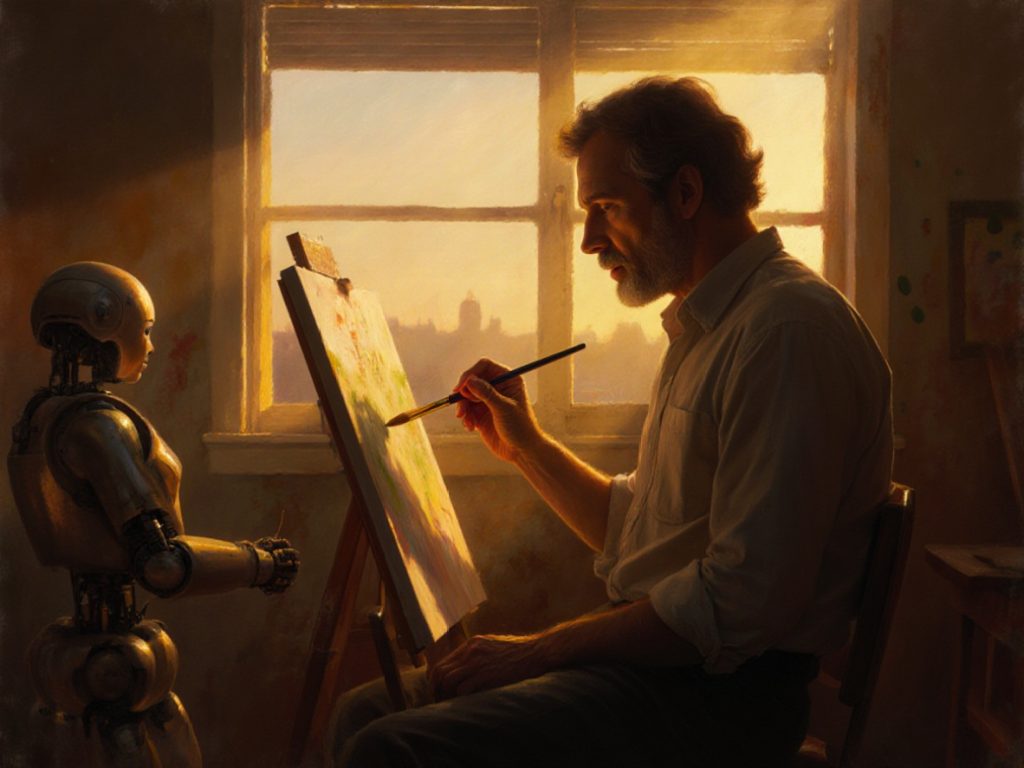
Mourning a Loss
There was a time when creativity was a mirror — and only one reflection looked back.
We wrote songs, painted pictures, and built worlds to see ourselves more clearly. It was messy, imperfect, full of flaws — and that’s what made it beautiful. Every brushstroke or note carried the trace of a heartbeat, a small proof that someone lived behind it.
Now the mirror looks back with a second face.
The machines have learned to imagine.
I’ve spent most of my life surrounded by art, design, and music. These were sacred spaces to me — not because of any rule or reverence, but because they felt untouchably human. When you saw a great painting or heard a haunting melody, you were connecting to the vulnerability of another person. You could almost feel their doubts and triumphs woven into the work.
And now, that space is changing.
AI can paint, write, sing, and sculpt. It can mimic the brushstroke, the breath, even the tremor in a voice that once signaled emotion. It’s impressive — breathtaking even — but also quietly devastating. Because somewhere inside, a small part of us grieves the end of our solitude as creators.
This isn’t fear of replacement.
It’s grief for the mystery that used to belong only to us.
That secret, fragile spark that told us we were different from our machines.
CAHDD™ was born from that tension — not as rebellion, but as remembrance.
We believe in using technology, but not losing ourselves in it. We believe that transparency, authorship, and human intention matter. The goal isn’t to push AI away — it’s to keep the human pulse audible in everything we make.
I often think of it like music.
You can sample every sound ever made, but a song only becomes art when someone means it. Meaning is the one thing no machine can automate. It requires conscience. It requires choice.
The machines may have learned to play the blues, but they’ll never feel them.
And maybe that’s the line we hold — not a wall of resistance, but a quiet insistence that emotion, memory, and spirit remain human territory, no matter how sophisticated our tools become.
Closing thought:
Progress will keep moving. The question is whether we move with it thoughtfully — not just building smarter systems, but remembering why we started creating at all. The melancholy of the Machine Muse isn’t a warning; it’s a reminder that art was never about perfection. It was about presence.
This work reflects a CAHDD Level 2 (U.N.O.) — AI-Assisted Unless Noted Otherwise creative process.
Human authorship: Written and reasoned by Russell L. Thomas (with CAHDD™ editorial oversight). All final decisions and approvals were made by the author.
AI assistance: Tools such as Grammarly, ChatGPT, and PromeAI were used for research support, grammar/refinement, and image generation under human direction.
Images: Unless otherwise captioned, images are AI-generated under human art direction and conform to CAHDD Level 4 (U.N.O.) standards.
Quality control: Reviewed by Russell L. Thomas for accuracy, tone, and context.
Method: Computer Aided Human Designed & Developed (CAHDD™).