
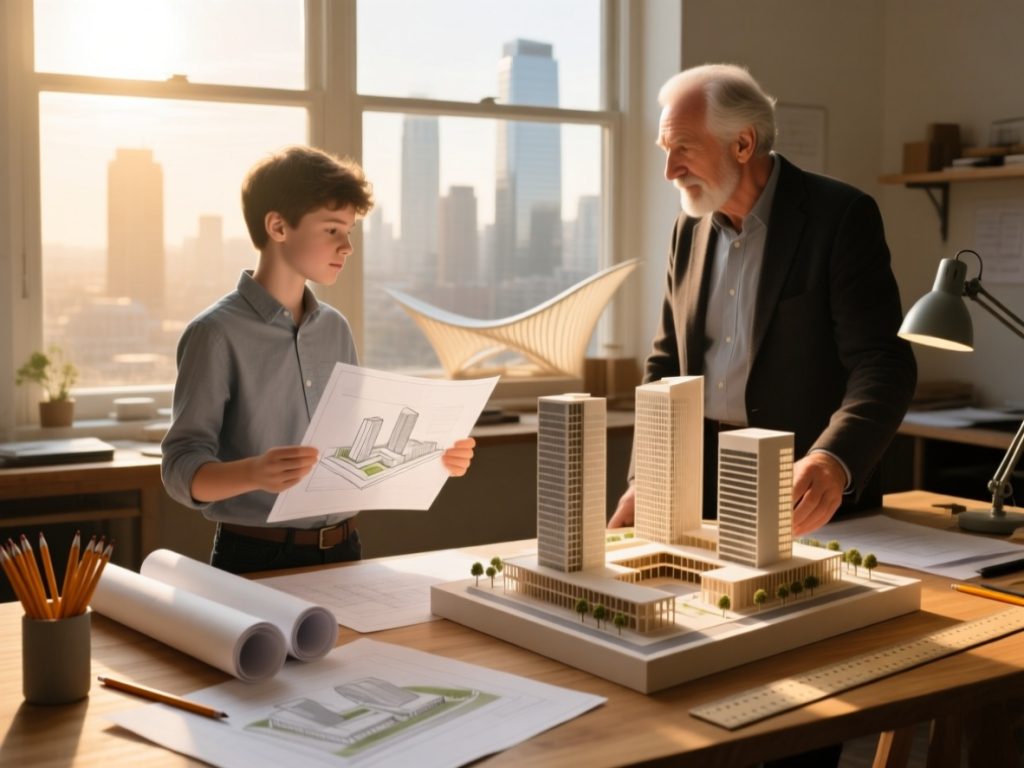
There’s a growing chorus insisting that AI tools capable of arranging FAR, setbacks, easements, parking ratios, and zoning envelopes are the “future of architecture.” You’ve seen the demos. A system ingests local codes, height limits, and floor-area constraints. It spits out a building massing that checks every regulatory box. And sure, it’s quick. It’s clean. It’s mathematically efficient. But here’s the truth no one seems willing to say out loud: this isn’t architecture. It’s automated compliance modeling.
Architects didn’t attend school, apprentice, and practice for decades just to be equated with spreadsheet geometry that happens to have a door. And calling this process “architecture” is how you strip the profession down to the same mechanical logic that guides finance algorithms and warehouse robots. It cheapens the very thing that makes the built environment meaningful. Good architecture has always started where mathematics ends.
What These AI Tools Actually Do
Let’s be honest about what these tools produce. They create the most efficient, code-compliant outcome for a given site. The results are efficient, logical, economical, standardized, predictable, and easily repeated across hundreds of parcels. In other words, they generate building envelopes that satisfy yield. That’s not architecture. That’s automated development modeling. These models respond to numbers—not to human beings.
Architecture Is More Than the Arrangement of Space
The technology crowd loves to redefine architecture as “the optimized arrangement of space to satisfy constraints.” That definition is convenient because it makes their generative models sound visionary. But architects know better. Architecture is a cultural act, an emotional experience, an artistic interpretation, a contribution to identity, a message about who we are, a promise to the people who will live there, and a response to psychological and sensory needs.
AI models don’t engage with any of this. They don’t experience a courtyard. They don’t feel relief stepping into daylight after a narrow hallway. They don’t understand how a small gesture in a façade can lift a tired soul. They can only rearrange patterns from the past. They cannot originate meaning.
What Should We Call This Category of AI Output?
We need a clearer term so the public—and developers—stop confusing it with architecture. Here are the most accurate descriptions: Automated Development Modeling (ADM); Algorithmic Site Solutions (ASS), a little tongue-in-cheek but not inaccurate; and Parametric Yield Optimization. These terms are grounded in data science and development economics, not in architecture. Because AI is not designing; it’s optimizing. And optimization is not creation.
The Context Where This Technology Actually Makes Sense
Let’s be fair. These models are useful when used appropriately. They excel at feasibility studies, yield analysis, maximizing FAR for developers, site testing before hiring an architect, quick volumetric studies, utilitarian projects with little design ambition, and budget-driven mass housing where expression is not a goal. These aren’t “bad” uses. They’re simply not architecture. They are tools to help architects and developers get to the starting line faster. Nothing more. Nothing less. But somewhere along the way, people started pretending the starting line was the finish line.
Where AI Falls Apart Completely
Ask any of these systems to design for joy, identity, cultural resonance, humility, hope, therapeutic qualities, a sense of place, restraint, memory, narrative, harmony, or dignity. They can’t do it. They have no concept of it. They can’t create a quiet corner where a person feels safe. They can’t create a moment that matters. They can’t create a building that becomes part of the story of someone’s life. AI has no lived experience—so it cannot design for human experience.
What it creates is mathematically valid, but emotionally vacant. Efficient, but forgettable. Compliant, but not compelling.
Architecture Begins Where AI Stops
This is the dividing line that everyone is stumbling over. AI can evaluate hundreds of permutations, optimize setbacks, calculate shadows, check zoning, and maximize revenue per square foot. AI cannot create beauty, express values, understand loss or joy, honor culture, interpret history, respond to subtle human needs, or produce something that inspires or restores.
Architecture is not the act of placing walls. Architecture is the act of placing meaning inside walls. And meaning cannot be generated by a machine that has never lived a human life.
The Danger Isn’t AI. The Danger Is Mislabeling.
AI tools are not the problem. The problem is developers—and some tech evangelists—who pass off automated massing as “architectural design.” If we normalize this, we end up with a built environment that reflects the cold, mechanical logic of spreadsheets rather than the richness of human imagination. But if we define these tools properly—if we place them in their rightful category—they become powerful assistants, not misguided replacements.
AI will give us more buildings. Architects will continue giving us places worth living in. That’s the line. Clear. Firm. Not up for debate.
This work reflects a CAHDD Level 2 (U.N.O.) — AI-Assisted Unless Noted Otherwise creative process.
Human authorship: Written and reasoned by Russell L. Thomas (with CAHDD™ editorial oversight). All final decisions and approvals were made by the author.
AI assistance: Tools such as Grammarly, ChatGPT, and PromeAI were used for research support, grammar/refinement, and image generation under human direction.
Images: Unless otherwise captioned, images are AI-generated under human art direction and conform to CAHDD Level 4 (U.N.O.) standards.
Quality control: Reviewed by Russell L. Thomas for accuracy, tone, and context.
Method: Computer Aided Human Designed & Developed (CAHDD™).