
The Question Everyone Keeps Asking
Why is it acceptable for humans to reference past work but controversial when AI does the same thing?
Humans Do Not Reference Casually
When a human borrows, quotes, or echoes another work, it is usually because something resonated. There is aesthetic appreciation. There is emotional response. Sometimes there is homage, parody, critique, or continuation. Even imitation carries awareness.
AI Does Not Experience Inspiration
AI does not see a piece and feel compelled to respond to it. It does not recognize nuance, subtext, or innuendo unless those patterns are statistically reinforced. What it produces is not an act of admiration or dialogue. It is an assembled output derived from harvested human work based on instruction.
Intent Is the First Line of Separation
Human referencing begins with intent. AI generation begins with a prompt. Those are not the same starting points, and they never converge later in the process.
je ne sais quoi
Call it inspiration, impulse, curiosity, concern, taste, discomfort, or wonder.
The word can change. The role does not.It is the moment when a human decides something is worth pursuing, before any tool is involved.
Scale Changes Everything
A human might reference another artist a handful of times across a lifetime. AI references human work every single time it generates output. At speeds and volumes that dwarf human capacity. This is not occasional influence. It is continuous extraction.
Compensation Was Never Part of the Equation
Original creators intended to be compensated for their work. That expectation collapses when their contributions are absorbed into systems that replicate style, structure, and expression without consent or attribution.
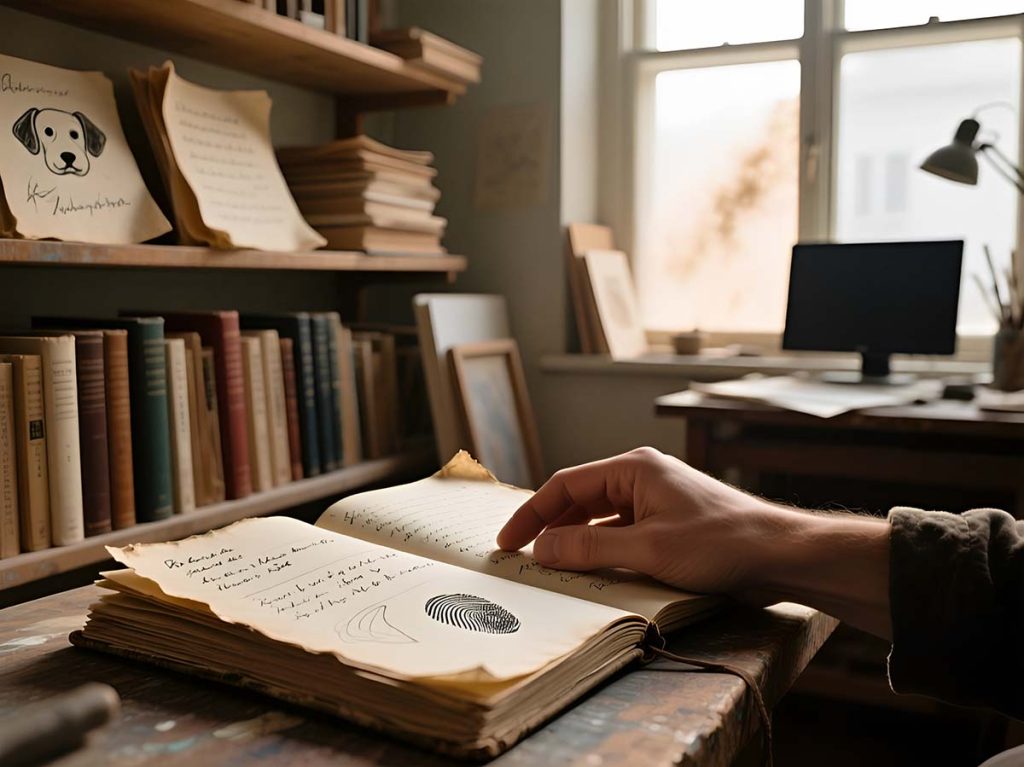
The Missing Fingerprint
Human work carries a fingerprint. Decisions, hesitation, taste, restraint, and context are visible in the outcome. AI output carries no such trace. It has no personal stake in what it produces, and no responsibility for what it replaces.
Why This Distinction Still Matters
Equating human inspiration with AI harvesting erases authorship. It treats lived creative experience as interchangeable raw material. CAHDD exists to keep that line visible, not to halt progress, but to ensure it remains accountable.
This work reflects a CAHDD Level 2 (U.N.O.) — AI-Assisted Unless Noted Otherwise creative process.
Human authorship: Written and reasoned by Russell L. Thomas (with CAHDD™ editorial oversight). All final decisions and approvals were made by the author.
AI assistance: Tools such as Grammarly, ChatGPT, and PromeAI were used for research support, grammar/refinement, and image generation under human direction.
Images: Unless otherwise captioned, images are AI-generated under human art direction and conform to CAHDD Level 4 (U.N.O.) standards.
Quality control: Reviewed by Russell L. Thomas for accuracy, tone, and context.
Method: Computer Aided Human Designed & Developed (CAHDD™).