The Problem No One Wanted to Say Out Loud
CAHDD™ (Computer Aided Human Designed & Developed) didn’t begin as a framework or a movement. It began with an uncomfortable truth that most creators felt but rarely said out loud: AI models were generating new images and ideas by absorbing the creative work of real human artists—without credit, consent, or acknowledgment. Brushwork, palettes, stylistic signatures, architectural tendencies, even storytelling patterns were being scraped, learned, and reused in ways that blurred authorship. Many artists recognized themselves in these outputs even though they had never touched the work.
Using AI for my own creative projects—especially automotive and concept art—made this even harder to ignore. When AI helped produce a background or refine a detail, there was a subtle but persistent sense that some invisible part of the work wasn’t truly mine. I wasn’t intentionally stealing from anyone. But I couldn’t pretend the influence behind the models didn’t exist.
The Moment of Personal Reckoning
That guilty feeling forced me to stop and ask myself something honest: How do I continue creating with these new tools without erasing the humans whose work indirectly feeds them? How do I avoid lying to myself—and to the people who view my work?
The answer wasn’t dramatic or complicated. It was transparency. If I openly acknowledged when and how AI contributed to a piece, my conscience cleared. There was no pretending. No ethical ambiguity. No blurry authorship. If AI generated a background, I said so. If it refined the lighting or helped resolve a shape, I acknowledged that too. And when most of the piece was created by hand, I declared that openly and with pride.
Realizing This Wasn’t Just My Struggle
Once I began working this way, something became immediately obvious: every creative professional—artists, designers, architects, illustrators, writers—was wrestling with the same question. Where do I end and where does the machine begin? What is my authorship in a world where AI is becoming a co-creator?
Creators had no shared vocabulary to communicate this balance. No ethical standard. No simple way to explain how a piece came to life. And without transparency, trust was beginning to erode.
CAHDD was born from that gap. It started as a personal code and quickly grew into a philosophy meant to protect the human side of creativity.
The Shift Toward Humanocentricus
As the idea matured, it became clearer that this wasn’t just about disclosing AI usage—it was about preserving human identity and human meaning in the age of intelligent tools. The underlying worldview had been there all along, but now it had a name: Humanocentricus. The belief that humans—not algorithms—should remain at the center of creativity, interpretation, ethics, and authorship.
Humanocentricus became the philosophical foundation beneath CAHDD. CAHDD is the practical framework, the toolset, the method. Humanocentricus is the why behind it all. Together, they form a balanced philosophy: humans lead, AI assists.
Developing the TechRatio Levels
Out of this came the CAHDD TechRatio Levels—a clear, honest system to communicate how much of a work was human-made versus AI-assisted. Not a certification. Not a gatekeeping tool. Just a transparent and universal language that lets creators describe their process without shame or ambiguity.
The TechRatio restores trust and gives audiences clarity. It also allows creators to embrace new tools responsibly, without erasing themselves in the process.
Where CAHDD Stands Today
Today, CAHDD stands as a human-centered design philosophy created by and for creative professionals. It protects authorship. It encourages transparency. It keeps humanity at the center of the creative process even as tools evolve.
We do not reject technology. We simply refuse to let it eclipse us. In design, in art, in architecture, in writing, one principle must remain: humans lead, machines assist.
CAHDD began with a personal moment of discomfort but grew into something much larger—a commitment to Humanocentricus and a belief that if we want a human-centered future, we must create in a human-centered way. Honestly, transparently, and without erasing the people behind the work.
This work reflects a CAHDD Level 2 (U.N.O.) — AI-Assisted Unless Noted Otherwise creative process.
Human authorship: Written and reasoned by Russell L. Thomas (with CAHDD™ editorial oversight). All final decisions and approvals were made by the author.
AI assistance: Tools such as Grammarly, ChatGPT, and PromeAI were used for research support, grammar/refinement, and image generation under human direction.
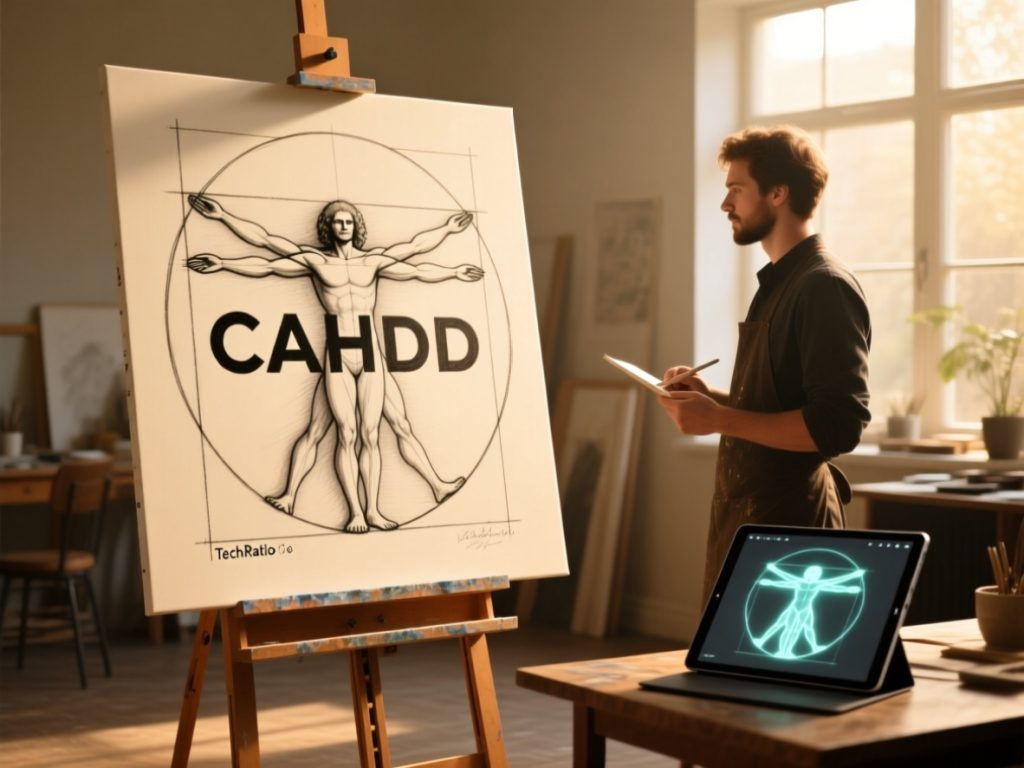
Images: Unless otherwise captioned, images are AI-generated under human art direction and conform to CAHDD Level 4 (U.N.O.) standards.
Quality control: Reviewed by Russell L. Thomas for accuracy, tone, and context.
Method: Computer Aided Human Designed & Developed (CAHDD™).