
Why Humans Mark Moments—and Why That is Important
There are things humans do that don’t make sense if efficiency is the only metric.
We wear the same socks on game day.
We keep a lucky coin in a drawer.
We sit in the same chair, even when others are open.
We know—logically—that these things don’t change outcomes. And yet, we do them anyway.
Not because they work.
But because they mean something.
That distinction matters more than we tend to admit.
The Small Rituals Nobody Notices (But We Still Keep)
Much of human life is built around quiet habits that go unnoticed by everyone but us. They don’t demand witnesses. They don’t need validation.
A certain pen for important signatures.
A jacket worn only on specific occasions.
A routine followed before a big decision.
These rituals are not superstition in the childish sense. They are anchors. They ground us in moments where uncertainty, pressure, or change threatens to flatten experience into something purely functional.
Ritual turns repetition into reassurance.
It reminds us that we are participants, not just passengers.
Why We Celebrate Things That Will Be Forgotten
We celebrate graduating daycare.
We attend high school valedictorian speeches that, if we’re honest, almost no one remembers in detail years later. We hold ceremonies for retirements, anniversaries, promotions, marriages.
From a strictly practical standpoint, many of these moments change nothing. Life continues much the same the next morning.
But humans don’t measure life only by utility.
We measure it by passage.
Ritual marks time in a way clocks never could. It says: this mattered enough to pause. Even if the memory fades, the act of acknowledgment remains part of who we were at that moment.
Before Writing, Before Cities, Before Systems
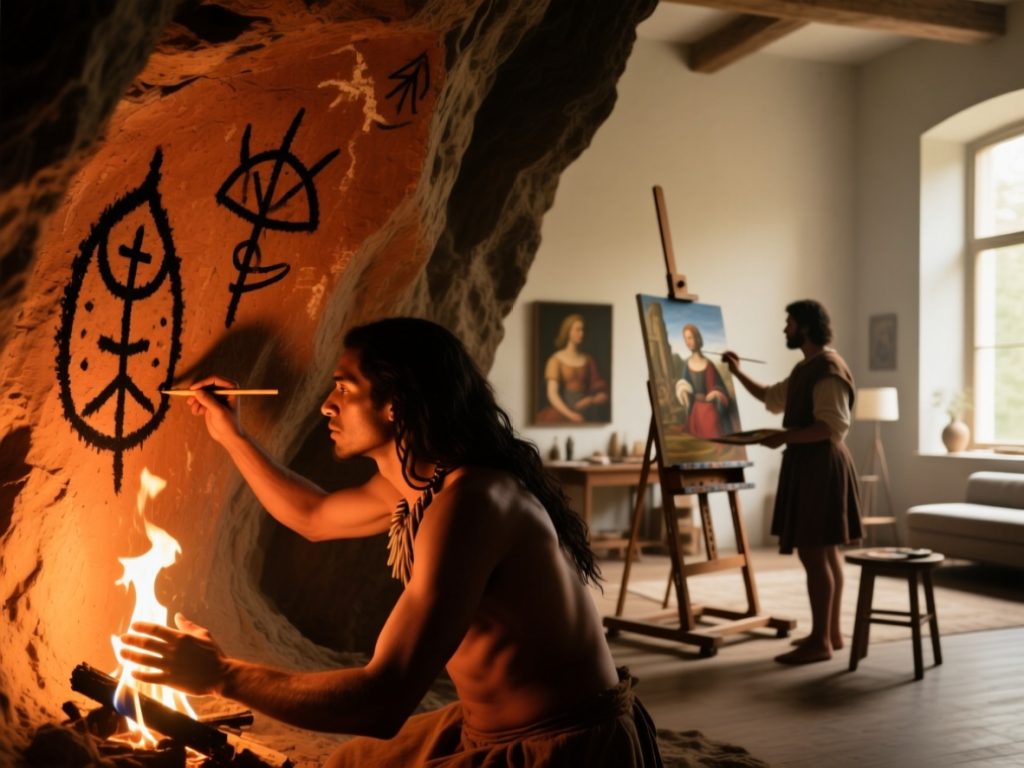
Long before contracts, calendars, or institutions, humans painted on walls.
They didn’t do it because they were told to.
They didn’t do it to optimize survival.
They didn’t do it because it scaled.
They did it because something inside them needed to be expressed.
Those early marks were not decoration. They were declarations—evidence of awareness, identity, and presence.
“I was here.”
“This mattered.”
“This is how I saw the world.”
We are still doing the same thing today.
What We Wear, How We Look, Who We Present Ourselves As
Clothing is not just protection from the elements. Hairstyles are not merely practical. Jewelry, tattoos, uniforms, colors—these are not random.
They are identity made visible.
Even when fashion cycles change, the impulse remains the same: to express belonging, difference, belief, or mood. These choices are deeply personal, even when influenced by culture or trend.
They are not optimized outputs.
They are human fingerprints.
Why Animals Don’t Do This—and AI Doesn’t Either
Animals have behavior.
AI produces output.
Neither creates rituals around meaning.
Animals do not mark milestones for remembrance.
AI does not celebrate transition.
Neither preserves objects because of sentimental attachment divorced from function.
This is not a criticism. It’s a boundary.
Ritualized self-expression is uniquely human. It exists outside efficiency, necessity, and optimization. And that is precisely why it resists automation.
The Quiet Loss We Rarely Talk About
As AI becomes more capable of producing convincing art, writing, and design, there’s a growing temptation to treat expression as interchangeable.
If the result looks right, why does origin matter?
Because expression is not just outcome.
It is intent, context, memory, and responsibility.
When we erase the distinction between creation and simulation, we don’t just lose authorship—we lose the thread connecting expression to lived experience.
What disappears first is not creativity, but meaning.
Why This is Important to CAHDD
CAHDD exists to defend the idea that human expression is not excess noise to be filtered out by smarter systems.
It is tradition.
It is ritual.
It is memory made visible.
These things don’t scale cleanly. They don’t compress neatly. And they shouldn’t.
The goal is not to reject AI.
The goal is to remember what makes human contribution irreplaceable.
From cave walls to graduation gowns, humans have always left marks—not because they had to, but because they needed to.
That need hasn’t disappeared.
And it deserves protection.
This work reflects a CAHDD Level 2 (U.N.O.) — AI-Assisted Unless Noted Otherwise creative process.
Human authorship: Written and reasoned by Russell L. Thomas (with CAHDD™ editorial oversight). All final decisions and approvals were made by the author.
AI assistance: Tools such as Grammarly, ChatGPT, and PromeAI were used for research support, grammar/refinement, and image generation under human direction.
Images: Unless otherwise captioned, images are AI-generated under human art direction and conform to CAHDD Level 4 (U.N.O.) standards.
Quality control: Reviewed by Russell L. Thomas for accuracy, tone, and context.
Method: Computer Aided Human Designed & Developed (CAHDD™).