Quick Summary
CAHDD™ is a voluntary, low-tech transparency system that helps creators show the “Human Sweat Equity” and technological participation behind their work. The CAHDD Stage answers how the work was created. The “Creator’s Mark” answers who stands behind it.
Creators can use our optional stage graphics, write CAHDD Stage 2 or CAHDD2, place a small ② on the work, or integrate the stage into a signature, logo, or studio credit. CAHDD is not a certification or quality rating. It is a visible, human-facing declaration that can work alongside Content Credentials, metadata, invisible watermarking, and platform labels. We also offer a free Photoshop tool for placing the official graphics.
Industry feedback helped us make this purpose more visible throughout the CAHDD website: giving creators a simple way to say, “I made this. This is how I made it. I stand behind it.”
What we learned about clarity, visible authorship, and giving creators a way to tell their side of the story
For centuries, people have placed their marks on the things they made.
Tradespeople stamped their tools and products. Craftspeople burned or pressed identifying symbols into their work. Artists signed paintings, architects placed their names on drawings, photographers added credits, and studios developed recognizable seals and logos.
Those marks carried more than identity. They represented judgment, reputation, pride, origin, ownership, and responsibility.
They said:
I made this.
We made this.
We stand behind it.
CAHDD™ carries that time-honored tradition into the digital age.
As we have continued speaking with artists, illustrators, visualization professionals, designers, and others throughout the creative industries, we have also learned that the CAHDD website was not bringing this human idea forward as clearly as it should.
We had developed the pieces, but we were making visitors work too hard to see how they fit together.
A Hard-Learned Lesson About Clarity
I have learned this lesson before, yet I have not always been smart enough to prioritize acting on it.
Recently, some neighbors heard my wife mention that my architectural rendering studio, 3DAStudio™, had won awards through the American Society of Architectural Illustrators. They asked about the studio, so I sent them a link to our website.
At the following week’s neighborhood block party, I mentioned that I had sent it. They looked perplexed and admitted that they did not understand what we actually did.
Did we design the buildings?
Were we photographers?
Were the buildings shown on the site even part of our work?
Yikes!
We had built a website that spoke to our colleagues and showed off what we could produce, but we had not clearly explained our role to a potential client who might know nothing about 3D rendering or architectural visualization.
It did not matter that we understood the distinctions. It did not matter that the explanations existed somewhere on the site. If a visitor could not quickly understand what we did and why they might choose us, then we had failed to communicate.
While reviewing the reactions to CAHDD, I realized we were doing something similar.
We had become so focused on the individual pieces that we were having trouble seeing the forest through the trees.
When the Message Received Is Not the Message Intended
Certain creative sectors are strongly opposed to AI, often for understandable reasons. Artists are concerned about unauthorized training, lost work, disappearing attribution, economic displacement, and the erosion of skills developed over a lifetime.
Some responses to CAHDD were openly hostile. A few people appeared to see us as AI advocates in disguise, promoting or normalizing the technology rather than protecting human authorship.
That reaction told us something important about the way the system was being presented.
Our stage icons appeared to become more focused, refined, or visually powerful as they approached the fully AI-generated end of the system. Although the stages were intended as neutral descriptions of different processes, the graphics could be interpreted as a progression toward a more advanced or desirable technological result.
The most visible areas of the website emphasized the stage icons and watermarks. Meanwhile, explanations that creators could use a simple circled stage, incorporate it into a signature or logo, or communicate it through text were scattered across different pages and articles.
Those ideas were present, but they were too easy to miss.
Even the human figure inside the CAHDD logo was intended to suggest a human identity within a circle, but that connection was clearer in our minds than it was to a first-time visitor.
We knew what all the pieces meant because we had spent years thinking about and developing them. Someone visiting the site for five minutes did not have that history.
The Article That Clarified Our Own Message
Recently, I wrote an article for the American Society of Architectural Illustrators blog titled “The Return of the Signature”.
The article focused on the long-standing human instinct to leave something of ourselves within the things we create. It looked at signatures, studio logos, craftsman’s marks, foundry stamps, architectural seals, and other forms of visible authorship.
The visual watermark and icon systems were described as tools. The larger idea was visibility.
That relatively concise article captured the human essence of CAHDD more directly than the much larger collection of information on our website.
It brought forward a simple idea:
Human beings have always marked what they create.
The tools and production processes may change, but people still want to say:
This came from me.
My judgment is part of it.
My reputation stands behind it.
The CAHDD stage system adds one more piece to that time-honored declaration by allowing creators to indicate how their work was made.
Honest Criticism That Helped Us See the Problem
Another moment of clarity came through Ricardo Eloy’s article for CG Connect and Chaos, “CAHDD: Architectural Visualization Proposes Its Own AI Transparency Label.”
Ricardo offered an honest assessment of what he saw on the CAHDD website. He recognized the ambition behind the project while raising legitimate questions about adoption, stage boundaries, governance, and how the system would be understood by the creative community.
My first reaction was defensive, for a millisecond I thought we covered that, then I realized Ricardo had done us a huge favor……
We had discussed those issues. We had explained that the official graphics were optional. We had shown that the stages could be represented through text or circled characters. We had addressed many of his concerns somewhere within the site.
But “somewhere on the site” is not the same as clearly communicated.
If an informed industry professional could spend time reviewing CAHDD and not immediately see something we considered fundamental, then we had made it too easy to miss.
Feedback does not have to agree with every part of CAHDD to be useful. Ricardo’s observations helped us see the difference between the system we understood and the first impression our website was creating.
Making the System Easier to Understand
We spent the remainder of the week reviewing the graphics, terminology, hierarchy, and presentation throughout the CAHDD website.
The objective was straightforward: someone visiting the site should be able to understand the basic system within minutes.
We adjusted graphics that could unintentionally make increasing AI participation appear more powerful or aspirational. We made the optional nature of the official icons and watermarks more visible. We brought the relationship between creator identity and process transparency forward.
Most importantly, we placed the “Creator’s Mark” at the front of the conversation.
CAHDD now presents the system through two simple questions:
The “Creator’s Mark” answers: Who stands behind this work?
The CAHDD Stage answers: How was this work created?
They may be used together, but CAHDD does not require a creator to adopt a signature, logo, or complete graphic treatment.
A small ② in the corner of a drawing can communicate the stage by itself. It tells the viewer something about the process, even when it does not identify the creator.
When that same ② is placed beside or incorporated into a signature, studio logo, byline, or project credit, it becomes part of a “Creator’s Mark” that communicates both identity and process:
I made this. This is how I made it. I stand behind my work.
A Low-Tech System for Showing “Human Sweat Equity”
CAHDD stands for Computer Aided Human Designed & Developed.
It is a deliberately low-tech transparency system for visually communicating how much “Human Sweat Equity” contributed to a creative or technical work.
“Human Sweat Equity” does not refer only to physical labor or hours spent working. It includes human ideas, knowledge, direction, experimentation, selection, composition, storytelling, refinement, restraint, experience, and final judgment.
Technology has participated in creative work for generations. Cameras, computers, rendering software, editing applications, digital fabrication tools, procedural systems, and generative AI have all changed the ways people create.
The useful question is no longer simply whether technology was involved.
The more informative questions are:
What did the people contribute?
What did the technology contribute?
Who accepts responsibility for the result?
The CAHDD Stage 0–5 and Stage X methodology provides a visual shorthand for communicating that human-to-technology balance.
The stages are not a ranking of artistic quality, professional value, morality, or technical advancement. Moving toward greater technological participation does not represent leveling up, and a lower stage is not automatically more virtuous.
Each stage describes a different creative process.
Four Ways to Indicate a CAHDD Stage
The stage methodology remains consistent, but creators have four primary ways to display it.
1. The Complete CAHDD Stage Graphic
Creators may use the complete CAHDD stage icons, labels, or watermark graphics.
We still value these graphics and consider them part of the CAHDD family. They are provided as a courtesy for creators who want a complete, recognizable, ready-to-use treatment.
To make the system immediately usable, we also offer the free CAHDD Watermark Manager for Photoshop, a Windows tool that helps creators place the official stage graphics on their work. It is provided as a convenience, not a requirement, but it turns the framework into something creators can use today.
The official graphics and Photoshop tool are optional implementations of the system, not mandatory requirements for participation.
2. The Written Stage Designation
The stage may be written in its complete form:
CAHDD Stage 2
This works well in project descriptions, portfolios, presentation notes, captions, contracts, credits, and transparency statements.
3. The Compact Stage Designation
When space is limited, the stage may be written in a compact form:
CAHDD2
This communicates the same classification without requiring the full written designation or a graphic asset.
4. The Circled Stage Character
The simplest visual expression uses the corresponding circled character:
⓪ ① ② ③ ④ ⑤ ⓧ
A circled stage can appear in the corner of an image, beside a byline, within project credits, following a studio name, or as a subtle screened element that does not compete with the work.
Its typography, line weight, color, scale, opacity, and placement may be adapted to the creator’s visual identity, provided the stage remains legible and is not used misleadingly.
These four expressions are not separate classification systems. They are different ways of communicating the same CAHDD Stage.
Creating a “Creator’s Mark”
Any of the stage indicators may be partnered with an existing form of authorship.
An artist may place ② beside a signature. A photographer may screen it into a logo. A studio may incorporate it into a project credit. A group or collective may place it beside its shared identity.
CAHDD does not ask creators to replace their signatures or logos with ours. We want to see the return of visible authorship, not the replacement of one identity with another standardized badge.
The CAHDD Stage supplies a consistent process language. The creator determines how that language relates to their own identity.
This creates a standard with flexibility.
A creator can use the complete icon when explanation is important, a written designation in a project description, a small circled stage on the work itself, or a stage integrated into a personal or studio “Creator’s Mark.”
Who Can Apply a “Creator’s Mark”?
A “Creator’s Mark” may represent an individual, a group of people, a studio, a team, a collective, or an organization.
In every case, identifiable people must stand behind it.
A machine cannot independently claim a “Creator’s Mark” because it cannot accept personal or professional responsibility. It has no reputation, judgment, pride, or accountability to attach to the declaration.
Software may physically place the mark under human direction, just as software may apply a signature, logo, watermark, or professional seal. The authority behind the mark, however, must come from the person or people accepting responsibility for it.
Under the CAHDD methodology, a “Creator’s Mark” applied without authorization from the people it claims to represent is a forged mark. The same is true when an automated system falsely implies that an identifiable creator or studio has reviewed the work and accepted responsibility for its stage declaration.
Technology may help make the work, document the process, and physically render the mark.
It cannot be the creator who claims the mark.
That responsibility remains human.
Working Alongside Digital Provenance
Governments, technology companies, and industry organizations are increasingly adopting machine-readable methods for identifying AI-generated or manipulated content.
The European Union’s Article 50 transparency obligations now require providers of covered generative AI systems to add machine-readable marks that enable certain AI-generated or manipulated outputs to be detected. The European Commission’s guidance explains the scope of those requirements.
Systems such as C2PA Content Credentials can preserve more detailed information about a file’s origin, tools, edits, and history. Some social-media platforms also use technical signals and creator disclosures to surface visible AI labels.
These systems serve an important purpose, and CAHDD can work alongside them.
The underlying digital record may contain extensive information, but the visible message presented to the public can still be reduced to:
AI was used.
That statement may not explain whether AI corrected grammar, removed photographic noise, generated a background, assisted with research, created an early concept, or produced most of the finished work.
Digital provenance can help record what happened to a file.
CAHDD gives the people behind the work a visible way to explain their role within that process.
One preserves the technical history. The other communicates the human story.
A Declaration, Not a Certification
A CAHDD Stage is a voluntary declaration. It is not a certification issued by CAHDD, and a graphic alone is not independent proof of how something was produced.
Its value comes from connecting a clear statement to people willing to stand behind it.
A traditional signature does not document every brushstroke. A maker’s mark does not record every tool used to produce an object. A studio logo does not explain every decision involved in a project.
Those marks still carry meaning because they connect the work to identity, reputation, and responsibility.
Supporting records, metadata, Content Credentials, invisible watermarks, project files, and production documentation can provide additional evidence.
Creators are encouraged to retain reasonable documentation of their process, such as work-in-progress files, drafts, layered source files, prompt logs, timestamps, metadata, or process videos. If a client, contest, partner, or legal proceeding requires evidence, that supporting material can help substantiate the creator’s Stage declaration and human contribution.
Maintaining this record can also help creators document authorship and creative contribution as questions surrounding AI, provenance, and intellectual property continue to evolve.
The visible “Creator’s Mark” and the embedded digital record perform different jobs, and they can support one another.
Why We Continue to Do This
We are repeatedly asked whether CAHDD is intended to become a commercial product or whether there is a financial motive behind the system.
CAHDD is a not-for-profit initiative developed by 3DAllusions LLC with the help of people who have contributed their time, knowledge, criticism, and support.
Our rendering studio, 3DAStudio, supports us financially. It pays for the work we do on CAHDD, the website, the graphics, the writing, and the tools we have developed. We have implemented and retrofitted the system within 3DAStudio as time and active project responsibilities have allowed.
CAHDD does not financially support the studio. The studio supports CAHDD.
We continue doing this because we believe the creative and design communities need a way to preserve visible human authorship while being honest about technological participation.
If there is an ulterior motive beyond trying to contribute something positive, perhaps it is ego in the most human sense. After decades in architectural visualization, we would like to believe that our experience has given us something worthwhile to contribute to the arts and design professions.
There is no hidden financial reward behind the stages.
We simply believe this is the right thing to do.
Across the Arts and Design Professions
Although much of our current outreach focuses on visual artists, architectural illustrators, designers, and other creative professionals, CAHDD is not limited to visual imagery or any single profession.
The same questions apply wherever people and technology participate in a creative process:
Who stands behind the work?
How was the work created?
In music, the system could help distinguish human composition, performance, recording, production, digital processing, synthesized elements, and generative assistance. In theater, it could apply to writing, directing, acting, choreography, set design, costume design, lighting, sound, and multimedia production. In film and cinematography, it could communicate the human and technological contributions involved in screenwriting, directing, camera work, editing, animation, visual effects, sound, and AI-assisted production.
The same flexibility extends across photography, architecture, illustration, writing, animation, industrial design, traditional crafts, digital art, and other forms of creative and professional work.
A project may use one CAHDD Stage to describe the overall process or identify different stages for individual components. A “Creator’s Mark” may represent one person, a creative partnership, an ensemble, a studio, a production team, or an organization.
We have included examples of how the system can apply across different disciplines on our How It Works and Who We Are pages. These examples are not intended to define every possible use. They demonstrate how the same simple methodology can adapt to the language, traditions, and working methods of different professions.
Wherever people want to identify who created something, explain how it was made, and stand behind their contribution, CAHDD can provide a flexible and visible language for doing so.
Making the Human Story Visible
The conversations we have had and the criticism we have received showed us where the website was doing too much explaining and not enough communicating.
We listened.
We adjusted the visual hierarchy, strengthened the language, and brought the “Creator’s Mark” forward so visitors could immediately see the human purpose behind CAHDD.
The official icons remain part of the system. The CAHDD Stages provide the methodology. Digital credentials and automated provenance offer valuable supporting technologies.
The “Creator’s Mark” places the human declaration beside them:
I made this.
We made this.
This is how we made it.
We stand behind our work.
It is a modification of a time-honored tradition for an age of digital creation and artificial intelligence.
It gives artists, craftspeople, design professionals, teams, and studios a way to tell their side of the story before an automated system tells it for them.
Creator choice, before platforms decide for you.
What’s embedded is inevitable. What’s visible is your choice.
Creator’s Mark: Russell L. Thomas
Overall classification: CAHDDⓧ — Stage X
This page combines written and visual components created at different CAHDD stages. The Creator’s Mark identifies who stands behind the work; the stages explain how it was made.
Written content: CAHDD③ — Stage 3. Human-authored and directed, with AI-assisted research, grammar, or editorial refinement. The author made all final decisions and accepts responsibility for the published text.
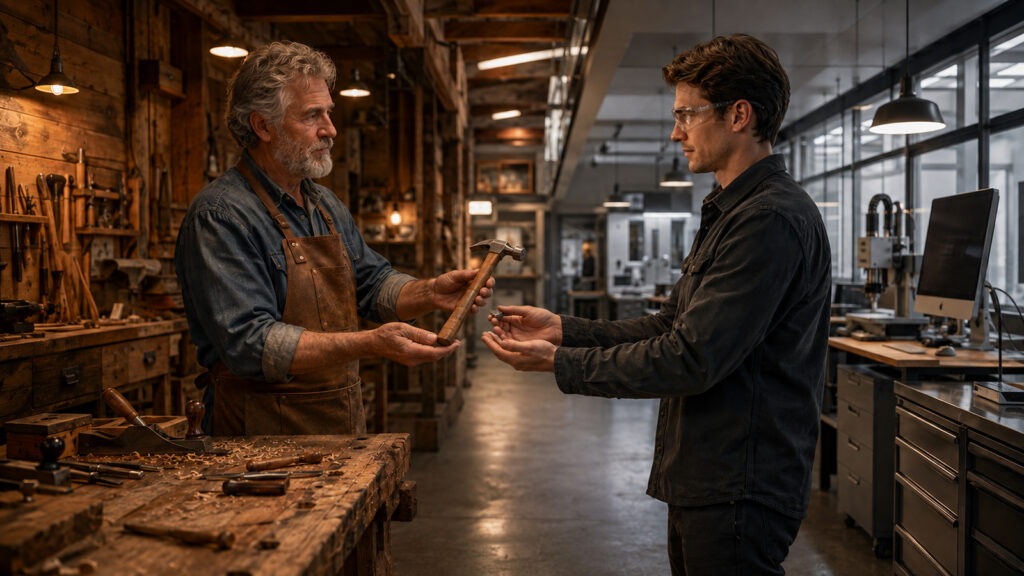
Images: CAHDD④ — Stage 4, unless individually captioned otherwise. Images were AI-generated under human art direction, selection, and approval.
Tools: Grammarly, ChatGPT, and PromeAI may have been used according to the roles described above.
Review: Reviewed by Russell L. Thomas for accuracy, tone, context, and final approval.
Method: Computer Aided Human Designed & Developed™ (CAHDD™).