
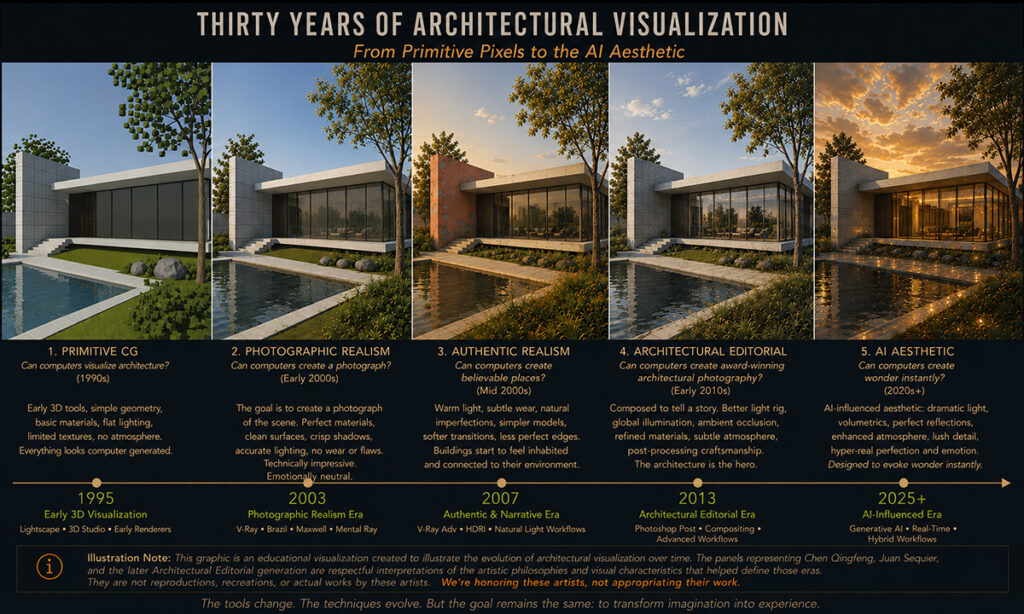
From Primitive Pixels to the AI Aesthetic
Every morning my inbox fills with emails from architectural visualization companies around the world.
Many of them contain beautiful work.
Sometimes breathtaking.
Increasingly, however, I find myself asking the same question:
Was this image created by an artist… or by artificial intelligence?
Interestingly, that question isn’t always easy to answer anymore.
And perhaps that’s because we’re asking the wrong question.
The real story isn’t whether AI is creating architectural visualization.
The real story is that after thirty years of evolution, AI has learned from the very artists who built our profession.
Looking Back
I’ve been creating architectural visualizations professionally since 1995.
Over those three decades I’ve watched our industry evolve from primitive computer graphics into images that are often indistinguishable from photography.
But it wasn’t one giant leap.
It was a series of artistic revolutions.
Each generation wasn’t simply trying to create prettier renderings.
Each generation was trying to answer a different question.
The illustration accompanying this article attempts to capture that evolution.
It is not intended to rank artists or define rigid eras. Instead, it illustrates how the artistic priorities of our profession changed over time while the goal remained remarkably consistent.
Primitive CG (1990s)
Can computers visualize architecture?
Early architectural visualization was about proving that computers could represent buildings at all.
Models were simple.
Edges were razor sharp.
Materials were flat.
Windows were often dark and reflective because modeling believable interiors wasn’t practical.
Lighting was basic.
Global illumination was still in its infancy.
Looking back today these images appear primitive.
At the time, they were revolutionary.
The Photographic Realism Era (Early 2000s)
Can computers create a photograph?
As rendering technology matured, a new goal emerged.
Photographic realism.
Artists like Chen Qingfeng demonstrated that computer-generated imagery could rival architectural photography.
Images became incredibly clean.
Glass sparkled.
Concrete was flawless.
Lighting became physically accurate.
Materials were nearly perfect.
The objective wasn’t emotion.
It was technical achievement.
The highest compliment an artist could receive was:
“I thought it was a photograph.”
Authentic Realism (Mid 2000s)
Can computers create believable places?
Then something changed.
Artists like Juan Sequier showed us that realism wasn’t enough.
Buildings needed history.
Materials needed subtle variation.
Spaces needed warmth.
Architecture needed to feel inhabited rather than merely modeled.
Juan’s work wasn’t revolutionary because it was dirtier.
It was revolutionary because it felt authentic.
His buildings weren’t abandoned.
They were lived in.
His scenes weren’t dramatic.
They were believable.
He reminded us that architecture isn’t experienced as perfect geometry.
It’s experienced as places where life happens.
Architectural Editorial (Early 2010s)
Can computers create award-winning architectural photography?
By the early 2010s, the conversation shifted again.
Rendering technology had matured.
Modeling tools became dramatically more sophisticated.
Rounded edges, richer geometry, better vegetation systems, HDR lighting, physically based materials, and increasingly powerful render engines gave artists unprecedented control.
But the real leap wasn’t technological.
It was artistic.
This generation—represented by artists such as Bertrand Benoit, Branko Jovanović, Peter Guthrie, Jeff Patton, and many others—treated architectural visualization less like computer graphics and more like editorial architectural photography.
Composition became more intentional.
Lighting became more restrained.
Post-production matured into an art form.
The architecture remained the hero.
These artists weren’t simply documenting buildings.
They were telling stories.
The AI Aesthetic (Today)
Can computers create wonder instantly?
Today we find ourselves in a fascinating new chapter.
AI hasn’t simply learned how to generate architecture.
It has learned the visual language developed over decades by thousands of artists.
Today’s AI-generated imagery often embraces:
- dramatic skies
- wet pavement
- cinematic grading
- lush landscaping
- perfect reflections
- volumetric lighting
- impeccable composition
Every image feels like it was captured during the most beautiful three minutes of the year.
Beautiful?
Absolutely.
Authentic?
Sometimes.
The distinction matters.
The AI Aesthetic
One of the most interesting developments isn’t that AI creates beautiful images.
It’s that human artists are increasingly creating images that resemble what AI has learned to produce.
For years AI was trained on the very best architectural visualization available.
Now we’re beginning to see the influence flow in the opposite direction.
The aesthetic AI learned from artists is beginning to influence artists themselves.
It’s a fascinating feedback loop.
One generation taught the machine.
Now the machine is quietly influencing the next generation.
The Best Software Companies Understand This
One of the reasons I’ve been encouraged by recent developments is that some of the industry’s leading software companies appear to understand this distinction.
Chaos, long recognized as one of the most influential companies in architectural visualization, has embraced artificial intelligence not as a replacement for artists, but as another professional tool.
Rather than abandoning architectural models in favor of text prompts alone, their recent development has focused on integrating AI into established visualization workflows through products such as Veras and continued enhancements across the V-Ray, Enscape, and Corona ecosystem.
The architectural model remains the foundation.
Human judgment remains in control.
AI enhances ideation, atmosphere, materials, lighting, and post-production while allowing experienced artists to guide every meaningful creative decision.
Other companies, including D5 Render, are exploring similar philosophies by embedding AI directly into professional visualization workflows instead of treating it as a completely separate creative process.
I believe this is where artificial intelligence becomes genuinely exciting.
Not because it replaces expertise.
Because it amplifies it.
Standing at the Crossroads
For those of us who have spent decades in this profession, the arrival of AI has been emotional.
There is a temptation to view it as the end of an era.
I understand that feeling.
Every generation eventually discovers that the tools they mastered are no longer the newest tools available.
But architectural visualization has always evolved.
From wireframes to radiosity.
From radiosity to global illumination.
From scanline renderers to physically based rendering.
From Photoshop cleanup to sophisticated post-production.
AI is simply the next chapter.
The choice isn’t whether technology changes.
It always has.
The choice is whether we continue to evolve with it.
Honoring the Artists Who Built the Profession
As I reflected on this article, I found myself thinking about many of the artists who quietly shaped our industry long before AI entered the conversation.
People like Chen Qingfeng, whose pursuit of photographic realism convinced an entire generation that computers could rival cameras.
Juan Sequier, who taught us that authenticity often mattered more than perfection.
Later came artists such as Bertrand Benoit, Branko Jovanović, Peter Guthrie, Jeff Patton, and countless others who elevated architectural visualization into a sophisticated form of visual storytelling.
I was fortunate enough to know many of these artists personally.
Along with Jeff Mottle of CGarchitect, they helped shape an extraordinary period in our profession through competitions, conferences, discussions, and a shared passion for pushing architectural visualization forward.
None of them were trying to teach artificial intelligence.
They were simply trying to become better artists.
Yet the visual language they created became the foundation upon which today’s AI systems learned.
Perhaps that’s one of the greatest compliments we could ever pay them.
Artificial intelligence didn’t invent this aesthetic.
It inherited it.
Where Does CAHDD Fit?
This realization has also influenced how I think about CAHDD.
When I first introduced the Computer Aided Human Designed & Developed (CAHDD) framework, much of the discussion naturally centered on how much AI had been used.
Today I think the more important question is different.
How was AI used?
Was it used for concept exploration?
Lighting studies?
Material refinement?
Post-production?
Image generation?
Creative collaboration?
Those distinctions matter.
They tell the story behind the image.
CAHDD has never been about discouraging technology.
It has always been about preserving authorship, transparency, and creative intent.
As AI becomes more deeply integrated into professional workflows, that mission becomes even more important.
The Human Story Still Matters
Perhaps that’s the greatest lesson these past thirty years have taught us.
The tools change.
The techniques evolve.
The software becomes more powerful.
Artificial intelligence enters the picture.
But the most important part of architectural visualization has never been the renderer.
It has always been the human being deciding what deserves to be shown.
The buildings still begin with architects.
The stories still begin with people.
And behind every memorable image—whether created with pencils, polygons, ray tracing, or artificial intelligence—is a person trying to communicate an idea.
That hasn’t changed in thirty years.
I don’t believe it will change in the next thirty either.
Illustration Note: The accompanying comparison graphic is an original educational visualization created to illustrate the evolution of architectural visualization over time. The panels representing Chen Qingfeng, Juan Sequier, and the later Architectural Editorial generation are respectful interpretations of the artistic philosophies and visual characteristics that helped define those eras. They are not reproductions, recreations, or actual works by these artists. We’re honoring these artists, not appropriating their work.
Creator’s Mark: Russell L. Thomas
Overall classification: CAHDDⓧ — Stage X
This page combines written and visual components created at different CAHDD stages. The Creator’s Mark identifies who stands behind the work; the stages explain how it was made.
Written content: CAHDD③ — Stage 3. Human-authored and directed, with AI-assisted research, grammar, or editorial refinement. The author made all final decisions and accepts responsibility for the published text.
Images: CAHDD④ — Stage 4, unless individually captioned otherwise. Images were AI-generated under human art direction, selection, and approval.
Tools: Grammarly, ChatGPT, and PromeAI may have been used according to the roles described above.
Review: Reviewed by Russell L. Thomas for accuracy, tone, context, and final approval.
Method: Computer Aided Human Designed & Developed™ (CAHDD™).