
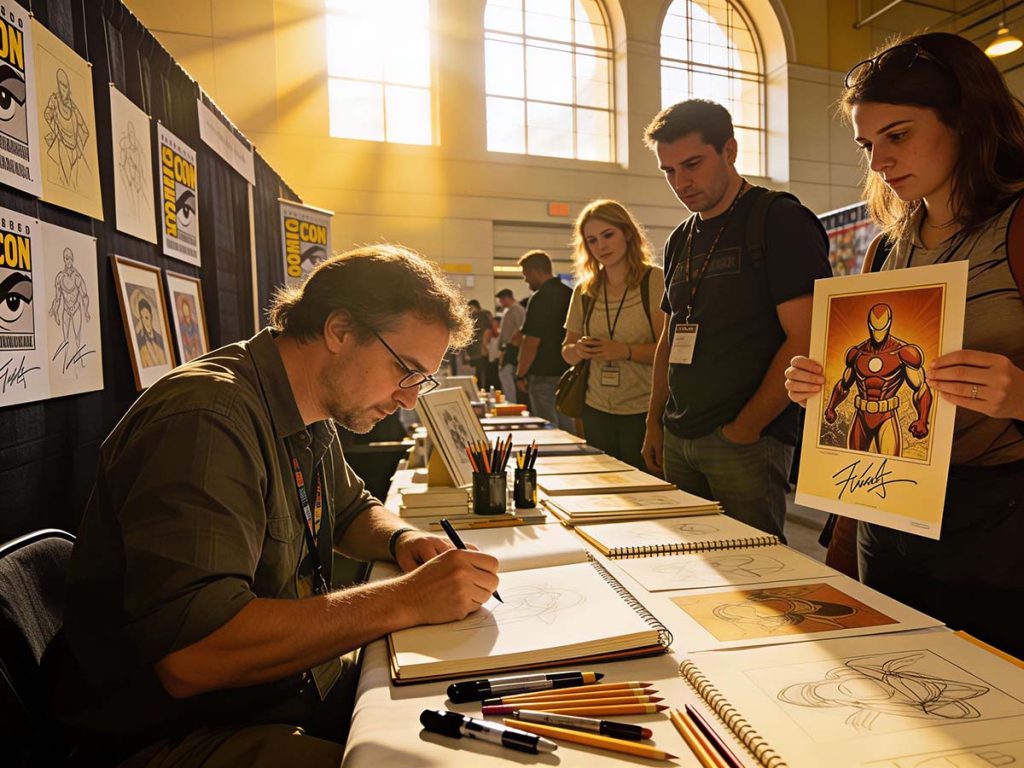
Something just happened in the fandom world that deserves more attention than it’s getting.
San Diego Comic-Con (SDCC), one of the most culturally influential gatherings in the creative world, has taken a clear stance by prohibiting AI-generated work from its Art Show submissions.
Whether you personally agree with that decision or not, it is not a small moment. Comic-Con is not a niche forum. It is a global signal. And the fact that this line was drawn there tells us something important:
This pressure has been building for a while. It is finally starting to surface in public.
Not because people “hate AI,” but because many communities still want something deeper than output.
They want authorship.
They want meaning.
They want the human fingerprint.
What Fandom Really Values (And It Isn’t Just the Image)
Fandom art has always been different from a generic content market.
People outside the culture sometimes view it as simple: posters, prints, characters, collectibles, fan art. But inside the culture, something else is going on. Something far more personal.
Fandom is not just about what the image shows.
It’s about who made it.
Fans follow artists. They recognize style. They remember names. They look for certain creators year after year. They share those names with friends like people share bands, authors, and filmmakers.
A fandom artist is not a faceless provider of “content.”
They are part of the mythology.
In other words, fandom doesn’t just value a picture.
Fandom values creator identity.
Why Creator Identity Matters More Here Than Almost Anywhere Else
In many markets, the creator gets pushed into the background. The work becomes anonymous. The brand wins. The platform wins. The algorithm wins.
Fandom doesn’t operate like that.
In fandom culture, creator identity is a form of trust. It is also a form of connection. People want to support artists whose work meant something to them. People want to meet them. Talk to them. Thank them. Collect their work over time.
That emotional thread is not a side effect.
It is the ecosystem.
And once you understand that, SDCC’s stance starts to make sense. This isn’t just about “AI images.” It’s about protecting an ecosystem where the maker still matters.
Style Lineage Matters (And People Know It, Even If They Don’t Say It Out Loud)
There is another layer to all this, and it matters even more than the debate usually admits.
Fandom art is full of lineage.
Art styles evolve like languages evolve. One artist influences another. Entire subcultures emerge. Techniques get passed down. Visual shorthand becomes recognizable across generations of creators.
That lineage is not corporate.
It’s human.
It is the accumulation of millions of decisions made by real people working through taste, experimentation, and dedication. It is the long, living history of art and influence.
When AI enters the picture without transparency, that lineage becomes vulnerable to something fandom culture has always disliked:
Extraction without acknowledgement.
Because when style becomes something you can summon instantly, it changes the relationship between the community and the work. It reduces tradition into raw material.
And even if some people struggle to articulate that, they feel it.
Collectors Don’t Just Buy Art. They Buy Origin.
There is a simple truth that tech culture often dismisses too quickly:
Collectors do not buy images.
Collectors buy authenticity.
Collectors buy provenance.
Collectors buy story.
Collectors buy the belief that a human spent part of their life creating something that did not exist before.
That is why the signature matters.
That is why edition numbers matter.
That is why “who made it” matters.
A collector’s instinct is not irrational. It is not old-fashioned. It is not anti-progress. It is actually one of the most ancient human impulses we have:
I want something real, and I want to know where it came from.
That is why fandom is not simply a consumer market. It is a culture of reverence. And reverence does not attach itself to outputs. It attaches itself to people.
SDCC Might Be The First Big Flashpoint, Not The Last
This is where the wider meaning shows itself.
SDCC’s move may be the first major flashpoint where a large institution said, publicly and clearly:
We are going to protect human-authored art.
But the underlying pressure is not isolated to SDCC.
It is rising in:
- fan art communities
- artist alleys
- juried art shows
- portfolio reviews
- collectors’ markets
- professional illustration circles
- concept art communities
These communities are not united by politics. They are united by values. And those values have always included an unspoken understanding:
When someone says “I made this,” it needs to mean something.
This Isn’t An Anti-AI Argument (It’s a Pro-Truth Argument)
Let’s say this clearly.
AI is a tool.
Like any powerful tool, it can be used in ways that are responsible, collaborative, and beautiful. It can enhance productivity. It can accelerate ideation. It can help people overcome skill barriers. It can be used as support.
None of that is the problem.
The real problem is when AI is used as a shortcut around honesty.
When AI is used to erase the difference between:
- handcrafted work
- hybrid work
- fully generated work
If the AI community wants wider adoption, it should not treat transparency like an inconvenience.
Transparency is the bridge.
It is how you prevent backlash from hardening into cultural rejection.
TechRatio as a Way Forward (Not a Scarlet Letter)
This is the moment where new norms are needed.
Not bans everywhere.
Not denial everywhere.
Not war between artists and technologists.
Just clarity.
TechRatio exists because we do not need to pretend.
We don’t need to hide that tools were used.
We need to disclose how they were used.
A simple transparency framework can lower tension because it replaces suspicion with honesty. It gives audiences an intelligent way to interpret what they’re seeing.
It creates room for hybrid workflows without erasing traditional craft.
And it protects the creator’s identity, which is what fandom is really defending.
TechRatio is not meant to shame anyone.
It is meant to stabilize trust.
What People Are Really Asking For (Even If They Don’t Know The Words)
Most people aren’t trying to write ethical manifestos.
They are trying not to be deceived.
They are trying not to be pressured into accepting a new normal that strips meaning out of creation.
They are trying to preserve something that is quietly sacred, even if modern culture stopped using sacred language:
Human-made work contains human life.
Even when it is imperfect.
Even when it is slow.
Even when it costs more.
Even when it is not “optimized.”
That is what people mean when they say they want authenticity.
They want the fingerprint.
Closing Thought
The creative world is not rejecting tools.
It is rejecting the erasure of the human creator.
SDCC didn’t just ban a category of images.
It exposed a truth that many people in fandom already know:
In a culture built on connection, the artist matters.
And as AI becomes more powerful, that truth isn’t going away.
It is getting louder.
If Authorship Still Matters to You
If you have ever looked at a piece of work and thought, “I want to know who made this,” then you already understand what this movement is about.
CAHDD supports visible human authorship in an age where it is increasingly easy to blur the origin of creative work. We use AI tools ourselves, and we believe they can be valuable, but we also believe the future depends on transparency, trust, and human accountability staying visible.
If you believe the future should include both powerful tools and honest disclosure, we welcome you.
Creator’s Mark: Russell L. Thomas
Overall classification: CAHDDⓧ — Stage X
This page combines written and visual components created at different CAHDD stages. The Creator’s Mark identifies who stands behind the work; the stages explain how it was made.
Written content: CAHDD③ — Stage 3. Human-authored and directed, with AI-assisted research, grammar, or editorial refinement. The author made all final decisions and accepts responsibility for the published text.
Images: CAHDD④ — Stage 4, unless individually captioned otherwise. Images were AI-generated under human art direction, selection, and approval.
Tools: Grammarly, ChatGPT, and PromeAI may have been used according to the roles described above.
Review: Reviewed by Russell L. Thomas for accuracy, tone, context, and final approval.
Method: Computer Aided Human Designed & Developed™ (CAHDD™).