
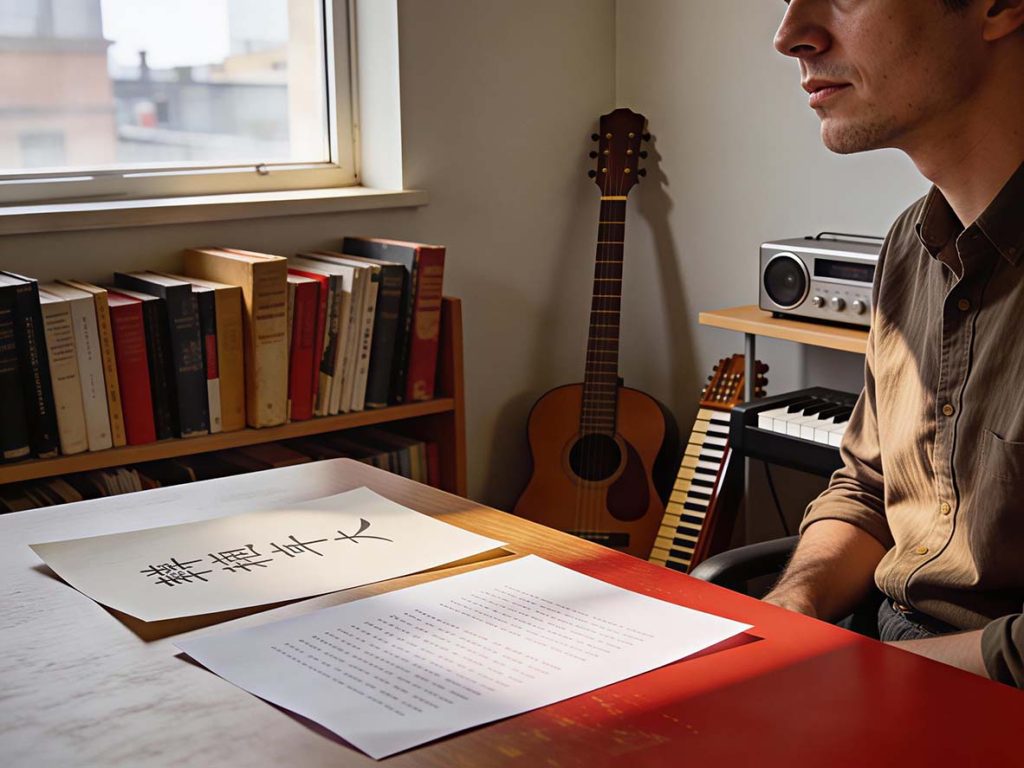
Nicholas Fung works at the intersection of language, cognition, and human learning, where technology meets the realities of how people actually think, listen, and communicate. With a background rooted in linguistics, music, and interpretation, his perspective challenges the way language and knowledge are traditionally institutionalized and taught. Rather than treating learning as something visual, procedural, or exam-driven, Nicholas focuses on the role of listening, neuroplasticity, and lived experience. In this interview, he reflects on where AI fits into that landscape, where it clearly falls short, and why preserving human judgment, nuance, and sensory engagement remains essential as technology becomes more embedded in creative and intellectual work.
1. Origin & Perspective
Q: Can you describe your creative background and the kind of work you do, in your own words?
A: My creative background is more on the language side. Language learning fails due to the fact that language learning is more institutionalize and it has become a departure from how we naturally learn through our ears. Institutions force students to learn through the eyes (Grammar Translation) to pass an exam. Most countries, after having learning a decade of, for e.g., English, have very little to show for. In fact, many devise their own methods and do much better.
My language coaching is primarily audio based through popular songs.
2. First Encounters with AI
Q: When did AI first enter your creative or professional workflow, and what was your initial reaction to it?
A: I came across AI probably the beginning of the year, more out of curiosity, to help me apply for jobs, ie, mostly writing. I thought it is convenient for organizing.
3. The Moment of Friction
Q: Was there a moment where AI felt either genuinely useful or genuinely limiting to you? What did that moment reveal?
A: Yes, the more demand I place on Ai, the more I find it limiting. Namely, it can refer, but not infer. Therefore, most of the time, you would need to re-instruct it. It revealed to me either they have to drastically revamp how this works, or I would only use it in a very specific work only.
4. Human Judgment in Practice
Q: How do you decide when to accept an AI-generated output and when to push back, refine, or discard it entirely?
A: I only use it for work that are menial. For example, it is very obvious that recruitment is highly dependent on AI rather than picking up the phone and talk to the person. So, using AI to compose resumes and cover letters is only fair. It is like a cat and mouse game that I really don’t like.
I lose patients when AI fail to infer, as I have indicated above. At that point in time, I would only limit it to a very specific task and do the inferences myself, and then perhaps use AI for more specific organization. You can only go so far to re-instructing it where doing things yourself is much
5. The Discipline of Resistance
Q: In your writing, you talk about pushing against “default presets.” How does that idea show up in your day-to-day creative decisions?
A: When I coach, I use very little AI, because AI can’t hear for you. No matter how you think AI could help you learn a language, it can’t replace a human coach with the nuances in your pronunciation, let alone a spontaneous discussion on the lyrics, where an experience occurs, and it is where learning/mentorship takes place.
6. Learning Through Correction
Q: What have you learned about your own thinking, taste, or blind spots by correcting AI rather than accepting its first answer?
A: That was a hard lesson. I thought that AI could infer. At best, AI could infer on a very superficial level: finding information on the internet. Anything that are more idiosyncratic would require meticulous instructions, which I have very little patience to write. To circumvent that, I would have to anticipate what mistake it might make, and break the task into smaller chunks.
7. Creativity vs. Convenience
Q: Do you think there’s a real risk of creative work becoming too smooth, too fast, or too easy? How do you personally guard against that?
A: Good artist create, great artists copy. I am still at the copying stage, and AI can’t copy for you. It can’t help you learn the chords on the guitar. It can’t help you stretch that pinky to reach the 13th note. Nor can it help you appreciate sounds, like a dissonance. Hence, I make sure I get back to reality by training myself through singing, playing music and calligraphy.
8. Language, Meaning, and Intent
Q: As a linguist and musician, how do you see AI affecting nuance, emotion, and meaning in human expression?
A: I have read an article already on how our vocabulary is shrinking due to people using AI to write. I find that reading more, which by and large is listening within yourself, helps. As an interpreter, I find that most people simply don’t understand that interpreters could only help you if you listen carefully. Unfortunately, I would say over 90 percent of the people don’t listen very well, and chaos ensues. And this chaos isn’t something that AI could detect.
9. Where AI Helps — Honestly
Q: Where do you think AI does belong in a healthy creative process, without replacing the human role?
A: AI could only work with healthy people. Recruitment could only be healthy when the phone is picked up and talk to the candidates. AI interpreting could only when there is a human being to audit the exchanges to make sure the parties are understanding each other. AI can’t detect when there is a derailment. It certainly has a better capacity to absorb a large amount of data and spit it back out with high accuracy. In fact, most people would respect an AI more with this build-in turn-taking. The know understand more they can’t interrupt the AI.
10. Where the Line Is
Q: Are there areas of creative or intellectual work where you believe AI should not lead or decide? Why?
A: My goal is to help people to gain more their neuroplasciticity more through listening. Hearing is the first sense we develop (we could hear from other mother’s womb) but it is the first to deteriorate. The only thing we could do better is coming up with something truly humanly original. AI serves the enhancer to a certain degree.
11. Advice to Other Creators
Q: What would you say to creators who feel either intimidated by AI or overly dependent on it?
A: This is tough question. I find that I am guilty of both. The only thing I could offer is to monitor AI’s mood carefully. Each new upgrade is like a mood change, and either you will be more dependent on it, or, in my case, I am getting more turned off by it and using it less. I feel that most people would get more sucked in, and we will become more AI centric, if we haven’t already.
12. Looking Forward
Q: As AI continues to evolve, what do you think humans will need to protect most about their creative process?
A: There is “art” that are very obvious that it is AI generated. My fear is that it becomes the standard. If that happens, we will loose more senses than hearing/listening. At this stage, most are only using it for memes.
13. A Question You Wish More People Asked
Q: Is there something about AI, creativity, or human judgment that you wish more people would ask about but rarely do?
A: I wish more people would scrutinize it more instead of blindly accept that it will take over and take over everything. A washing machine takes over washing by hand, but it doesn’t take over your hands to do other things, especially creative things. Don’t farm your thinking off to much to AI.
Closing Reflection
This conversation sits at the crossroads of language, listening, and human judgment — a reminder that not all learning, creativity, or understanding can be accelerated, automated, or optimized. As tools continue to evolve, the discipline of paying attention, refining one’s own thinking, and remaining engaged with the physical and sensory world remains a distinctly human responsibility.
Interview Transparency Note
This interview presents the interviewee’s responses to a fixed set of questions prepared by CAHDD. The answers are shared in the interviewee’s own words and reflect their personal experiences, observations, and perspectives. Responses are not edited to alter meaning or intent.
Imagery accompanying this interview was created using CAHDD-aligned workflows and may include AI-assisted processes up to CAHDD Stage 4 (AI-Generated, Human-Curated). All final selections, context, and presentation decisions remain under human direction.